


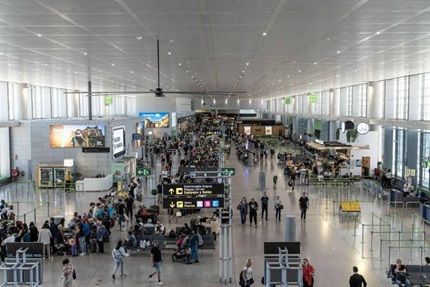
The Airports Company South Africa (ACSA) invested R825 million in technology during the 2025/26 financial year, as it accelerates efforts to transform South Africa’s airports into smart, digitally-enabled transport hubs. This is according to ACSA chief technology officer Vishalan Govender, in an e-mail interview with ITWeb. The investment comprises R266 million in capital expenditure (capex) and R559 million in operating expenditure (opex).
The spending comes as the state-owned airport operator expands digital services for travellers, strengthens airport security systems and prepares to introduce new artificial intelligence (AI) capabilities, augmented reality navigation and e-commerce functionality through its mobile application. According to Govender, the investment reflects the organisation’s commitment to modernising both customer-facing and back-end airport technologies.
“This investment supported infrastructure modernisation, cyber security, airport systems, passenger-facing digital services, analytics, operational resilience and the continued evolution of ACSA’s smart airport capabilities,” he said.
It forms part of a broader digital transformation programme aimed at improving passenger experience, while enhancing operational efficiency and security across ACSA’s network of airports. Central to the strategy is the ACSA mobile application, which was launched on 1 July 2022 and has steadily seen increased use among travellers. As of 30 January 2026, the app had recorded more than 156 882 downloads across Android, Apple’s App Store and Huawei’s HarmonyOS AppGallery, Govender said.
He explained that usage typically rises sharply during busy travel periods, including public holidays, school vacations and the festive season. Passengers primarily use the application to track flights, book parking and access airport information before and during their journeys.
According to Govender, the app has evolved into a digital companion for travellers, offering live flight status and notifications, airport navigation, retail information, parking reservations, ticket payments, baggage tracking and transport information.
Other functions include customer feedback tools, a chatbot and live chat support, customer surveys, airport notices, health and safety information, marketing campaigns and a whistleblowing channel.
ACSA is preparing a series of quarterly updates to the application during the 2026/27 financial year as part of a roadmap to add new smart airport capabilities, Govender revealed. The first quarter update will introduce a “Rate Us” feature that allows passengers to evaluate airport facilities and services, alongside an airport congestion indicator to provide travellers with real-time visibility into passenger volumes.
The second quarter release will add augmented reality wayfinding, functionality aimed at assisting passengers with disabilities, links to customs declaration forms and a virtual interlining pilot.
In the third quarter, ACSA plans to introduce an AI-powered chatbot to improve customer support, together with airport stakeholder enablement functionality. The final quarter release will expand the platform further with employee-facing functions, including food ordering, additional stakeholder capabilities and the first phase of an e-commerce offering.
Beyond the mobile application, ACSA has invested heavily in technologies intended to modernise airport operations.
Govender said these include baggage tracking, self-service passenger processing, electronic gates, common use passenger processing systems, common use self-service check-in capabilities, smart parking, website enhancements and digital payment enablement.