

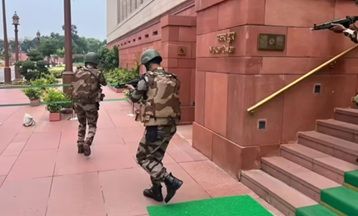
The Central Industrial Security Force (CISF) has reinforced security at the Parliament House Complex (PHC) in New Delhi after a detailed review with the deployment of over 3,300 personnel. “The upgraded security framework of CISF covers access control, perimeter & internal security, counter-terror preparedness, and emergency response,” a CISF spokesperson said.
According to the spokesperson, over 3,300 personnel are deployed with advanced screening systems and specialised training in Drone, Cyber, Chemical-Biologist-Radiological-Nuclear (CBRN) and National Security Guard/Army modules, ensuring a robust multi-layered setup.
According to the spokesperson, revised posting norms, strict protocols, and regular multi-agency drills have been put in place to enhance the readiness of the CISF personnel.
“CISF remains steadfast in its commitment to safeguard the nerve centre of Indian democracy by providing a secure and resilient environment at all times,” the spokesperson stated.
It was May 2024, CISF had started inducting specially trained security personnel for the protection of the Parliament ever since a security breach inside the Parliament took place in 2023.
Before taking over the security charge of Parliament, the CISF personnel went under fire wing refresher training course, X-BIS screeners training as well as frisking and checking training, dog squad training, Bomb-Detection and Disposal Squad (BDDS) refresher course, communication and CCTV training, QRT+CAT training, sniper training and armed support training.
The decision to assign CISF for Parliament security duty was taken by the Ministry of Home Affairs last year following an incident that took place on December 13, 2023, when two intruders named Sagar Sharma and Manoranjan D, entered the Lok Sabha chamber from the public gallery and jumped onto the tables from the public gallery and released a yellow-colored smoke canister.
Earlier, it was the Parliament Security Service (PSS), which provided security inside Parliament. The PSS, headed by the Joint Secretary (Security), used to look after the security setup in the Parliament House complex.
It is worth mentioning that the then president of the Central Legislative Assembly, Vithalbhai Patel set up a ‘WATCH AND WARD COMMITTEE’ on September 3, 1929. It was later renamed as the PSS in 2009. The PSS was the In-House system to provide proactive, preventive and protective security to the VIPs and VVIPs, buildings and its incumbents.
The PSS was solely responsible for the management of access control and regulation of people, material and vehicles within the Parliament House Complex. The PSS was also assigned with the marshal duty in the House.