


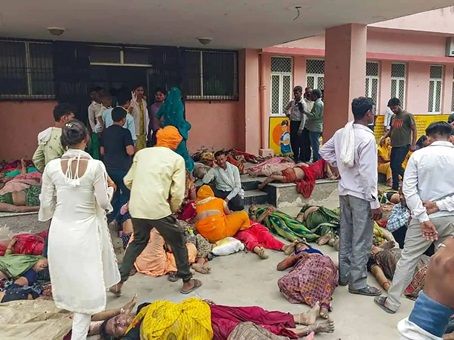
A day after a stampede in Hathras claimed 121 lives, Uttar Pradesh minister Asim Arun, and also a speaker at the SECURITY TODAY Knowledge Summit 2020 said the state government has started work on SOPs for granting permission for large gatherings to prevent such incidents in future. Just as has been done countless times when religious superstitions have caused the blinded followers to cause a stampede leaving death in its wake.
He said Chief Minister Yogi Adityanath has instructed officials to prepare the standard operating procedures (SOPs) and permission for events would be granted only if the “basic, minimum” conditions for amenities are met.
Arun, the minister of state for social welfare, is part of a three-minister committee formed by Adityanath for supervising the relief measures in the aftermath of the stampede. Explaining how the tragedy unfolded, he said, “It appears sevadars (volunteers) who were managing things inside did something wrong in terms of crowd management and that is another lesson learnt.”
“We should not leave it to sevadars or volunteers. They do a great job, of course, but the police and magistrates are more experienced,” he said. So, the chief minister has decided that the state will have more detailed SOPs now for any such gathering, whether it has 1,000 or 100,000 people, the minister said.
“It’s not just this, it’s about civic amenities as well, like how many toilets are required for 80,000 people or how many water tankers should be there and how many escape points should be there,” Arun said. “So, he (CM) has instructed us to make a detailed SOP and all future permissions would be granted only if these amenities are taken care of either by the organisers themselves or by a government agency,” he added.
 On the negligence on the part of organisers of the satsang, the minister said there were quite a few. “There was inadequate space for parking and hence a large number of buses were parked on the national highway. “There should be multiple entry and exit routes and I believe they were only two routes as far as I have seen. So, the organisers could certainly have done better,” he said. He said if it was a smaller gathering or if it was pleasant weather, maybe it would have worked. But yesterday was a sultry day and later it rained.
“I think multiple factors were at play there. We have to improve our processes,” he said.
“Whether the government is organising an event or a private person is organising an event, our SOP will be very clear on what kind of basic minimum standards have to be met for us to permit any such events to take place,” he added.
A classic case of too little too late in spite of the fact that similar incidents have happened several times in the past and similar SOPs have been declared without any of it being adhered to. Anticipation…a crucial factor in such gatherings is simply a forgotten issue. The very fact that in the Hathras event, it was expected what size the crowd would be, no such crowd control measures were in place.
A stampede becomes deadly simply because a crowd surges beyond the capacity of a space, moving in the same direction at the same time. During a stampede, people collide and pile up against or on top of one another. As they fall, panic sets in and in desperation they tend to ignore whether their desperate effort to survive is crushing another person. This individual desperation simply spreads and kills.
Stampedes can occur due to various reasons. Some of the hazards include:
● Overcapacity
● Poor crowd control
● Poorly planned event spaces with no clear exits
● Narrow spaces
● Bulky or dangerous structures
While many people may fall and get trampled on during a stampede, the most common cause of death is compressive asphyxia, a dangerous condition that happens when breathing is prevented by external pressure on the body.
Humans take in oxygen through respiration by moving air in and out of our lungs. While our blood transports oxygen to the cells in our body, carbon dioxide, a waste product, is transported out of our body via the same system.
 During a stampede, people who are stuck in the crowd crush against one another. This means there is no room to move. This limits the diaphragm, a major muscle responsible for respiration, from contracting (tightening) and flattening (relaxing), which means air cannot enter or leave the lungs.
When this happens, it can quickly lead to compressive asphyxia with a build-up of carbon dioxide and lack of oxygen. The human body cannot function without oxygen for long as it can quickly lead to organ failure and brain death. Women generally have smaller frames and more body mass in their upper chest. If pressure is exerted there during a stampede, the impact can be detrimental for women.
The potential for a crowd surge exists any time a large number of people gather together in one place. While crowd density is a contributing factor, there is usually some sort of inciting event that acts as a catalyst to get large numbers of people moving in the same direction at the same time. Sometimes the crowd is trying to get away from an actual or perceived threat, such as a person with an unauthorised firearm or a severe thunderstorm.
A crowd surge can also occur when a large group of people moves toward something en masse. The main cause of death from a crowd surge is asphyxiation. Victims are squeezed so tightly that their lungs are not able to expand sufficiently to draw oxygen.
A large group of people moving in the same direction can pose many risks, particularly for individuals caught trying to move in another direction or individuals caught in the front of the crowd. Crowd surges are caused by a large group of people moving toward an object, usually a stage or entrance, with little room to move. The unfortunate result is dangerously compacting the crowd, often crushing individuals.
A stampede, however, involves a crowd moving quickly. This type of crowd even occurs when people have room to run or walk, usually away from a perceived danger or toward a goal. This event can be just as dangerous and can occur in similar situations. For example, a crowd rushing toward a stage or fleeing an event venue due to an unexpected threat.
 Proper planning and crowd management can prevent crowd surges and stampedes. Today, for ticketed large events, there’s usually extensive risk assessment, planning and operational control. Organisers can monitor and spot the risk as it unfolds and take real-time actions. Planning includes computer modelling of the event in terms of crowd movement, estimating evacuation times, and monitoring how people enter and leave the premises, among other factors.
However, these steps are not necessarily taken with religious mass gatherings.
For planned events organisers and venues can use barriers to manage and separate crowds to reduce the risk of life-threatening surges. While security officers and crowd spotters can be helpful, barriers are essential for separating the crowd and reducing the risk of both surges and stampedes.
Barriers prevent the crowd from crushing too closely into a specific point. By putting defined barriers throughout the crowd, they effectively reduce the number of people in each crowd and essentially create several smaller crowds all gathered together to attend the same event, which can reduce the risk of crowd surges.
It may be helpful to have barriers that can be raised or lowered as needed to allow for an emergency exit. The configuration of the barriers is important. Effective designs can be a powerful crowd management tool, but a poorly thought-out configuration can lead to more injuries due to members of the crowd becoming trapped against the barriers. The barricades should be configured to allow a route of egress.
Portable barriers can be configured in such a way that they separate the crowd into smaller, more manageable groups. They can also help to direct the crowd in a certain direction to allow for safer, more effective movement and to create clear paths for first responders to navigate during an emergency.
Sliding gates are not only vehicle crash rated but also designed to prevent pedestrians from entering or exiting unwanted places. Once open, however, sliding gates allow the safe flow of vehicle and pedestrian traffic. These gates can be used to prevent crowd surges and can be retracted safely if a crowd is gathered at one or both sides of the gate.
This allows organisers to prevent crowds from forming in unwanted areas and they can also be used to divide crowds to reduce the size and risk of surges. Sliding gates aren’t suitable for portable, temporary situations but can be helpful additions to venues where crowds frequently gather.
In Indian context, stampedes have almost always happened during religious gatherings where the fervour of people almost forces them to ignore their own safety. It is for the organisers to ensure that they make preparations to anticipate and mitigate such happenings.
 To ensure the safety of all attendees, it’s crucial to follow these five safety measures:
1. Control the Crowd Flow
Effective crowd management is key to preventing stampedes and crowd surges. Organisers should design entry and exit points to allow smooth movement of people. Use barriers and signage to guide the crowd and prevent bottlenecks. The aim should be to keep the crowd moving. Security personnel should be strategically placed to monitor crowd behaviour and manage any surges.
2. Monitor and Manage Capacity
Overcrowding is a primary cause of stampedes. It is essential to keep the number of attendees within the venue’s capacity. Pre-event ticket sales and entry monitoring can help maintain a safe number of participants. Additionally, having a clear understanding of the venue’s maximum capacity helps prevent overcrowding. Media reports indicate the Hathras venue where the recent tragedy took place was three times over its capacity!
3. Communicate Clearly
Clear and consistent communication with attendees is crucial. Use public address systems, digital screens, and signage to provide information about exits, emergency procedures, and event schedules. In the case of an emergency, provide calm and clear instructions to prevent panic.
4. Train and Equip Staff
Staff and security personnel should be well-trained in crowd management and emergency response. Conduct regular drills and ensure everyone knows their roles during an emergency. Equip staff with radios and other communication tools to coordinate effectively during the event.
 5. Prepare for Emergencies
Have a comprehensive emergency plan in place. This plan should include protocols for crowd control, medical emergencies, and evacuation procedures. Ensure that there are sufficient medical personnel and first aid stations on-site. Emergency exits should be marked and accessible.
India has been treading on a similarly dangerous path for a while now. According to a study published in the International Journal of Disaster Risk Reduction, religious gatherings and pilgrimages account for 79 percent of stampede incidents in the country. The fact that many significant temples are situated on hills, riverbanks, or other uneven terrains plays a big role.
Most incidents have similar common threads: poor amenities, narrow exits, a superstitious trigger, ignorance from authorities to follow the National Disaster Management Authority (NDMA)’s crowd management recommendations published in 2014 and inefficient responses.
The biggest common thread, though, is the inability to take lessons and action. With every stampede, it seems that people don’t get shocked by 150 deaths anymore. There are no protests, no demands of accountability and the grief becomes exclusive to the kin once the news value runs its course.
Religion is a sensitive and sacred matter in India, and rightfully so. But until the dangers of superstitions and the sensitivity to separate all of it from human lives are taken equally seriously, a solution for one of India’s biggest issues will remain elusive