


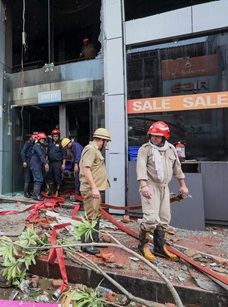
A detailed fire risk and infrastructure assessment, commissioned by the Union home ministry (MHA) in 2011, had identified severe gaps in Delhi’s firefighting infrastructure, manpower and emergency response systems, recommending large-scale expansion and modernisation measures that remain only partially implemented. Over 15 years later, most of the recommendations are still only on paper.
The contents of the report find fresh significance in light of a series of deadly blazes in the Capital that have highlighted deficiencies in the city’s fire safety preparedness. The report, titled “Fire Hazard and Risk Analysis in the Country for Revamping the Fire Services in the Country”, was prepared by a risk management agency for the directorate general of National Disaster Response Force and civil defence, under the MHA.
The study, a Geographic Information System-based analysis, found that Delhi at that time had 51 operational urban fire stations, one rural fire station and a training-cum-support centre at Fire Safety Management Academy (FSMA), Rohini. At first, the report noted that “taking the vehicle speeds and response time as per SFAC norms, Delhi requires an additional 120 fire stations in urban areas and 10 rural fire stations/posts.”
However, it said, it would be highly impractical to set-up so many fire stations in Delhi, where land availability in urban areas is scarce. The report then, based on response-time analysis and mapped jurisdiction gaps, concluded that the city required 46 additional urban fire stations and nine rural fire stations or posts, apart from the 18 that were under construction at that time. This, it said, was “an overall deficiency of 51% in terms of number of fire stations”.
Today, the city now has a total of 71 fire stations. The report also found an estimated 63% shortage in firefighting and rescue vehicles. Among the additional vehicles, it recommended 108 water tenders, 43 water bowsers, 59 foam tenders, 15 quick response teams, 13 motorcycle mist units, advanced rescue responders, hydraulic platforms, hose tenders and breathing apparatus vans.
The report specifically highlighted the need for smaller and faster emergency response systems in congested areas of Delhi. For these areas, it recommended QRTs and motorcycles with mist sets for the fastest response.
The manpower shortage identified was equally significant. The report estimated an overall manpower deficiency of about 79% in Delhi Fire Services. It recommended recruitment of 5,766 additional personnel for operational and proposed urban fire stations and another 287 personnel for rural stations and posts.
It also estimated an 82% deficiency in specialised equipment for both operational and proposed fire stations, such as breathing apparatus sets, thermal imaging cameras, hydraulic rescue tools, chain saws for concrete and wood cutting, smoke exhausters, portable pumps, inflatable lighting towers, gas detector kits, life locator devices and communication systems.
The report said, “there is an urgent need for a fire prevention wing for inspection, awareness generation and training for schools, hospitals, high-rise buildings, government offices, public buildings etc.”
It also flagged structural and technological shortcomings within the department. It recommended complete computerisation of Delhi Fire Services, GPS-based tracking of vehicles, intranet connectivity across stations and development of a fully computerised response system.
The report estimated that modernising DFS and filling the identified gaps would require an investment of about ₹4,927 crore over 10 years. However, despite the recommendations, several of the gaps flagged in the study continue to persist across the Capital.