


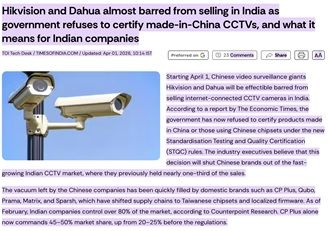
Recent headlines by major media outlets such as Times of India and India Today, and many others, including social media posts have sparked concern across the security industry, claiming that Chinese CCTV giants like Hikvision, Dahua, and TP-Link are “almost barred” or effectively banned from selling in India starting April 1, 2026. However, a closer examination of official government communication, and subsequent industry responses, reveals that these claims are misleading and stem from a misinterpretation of existing regulatory developments.
The reality is far less dramatic.
 There has been no fresh notification or circular issued by the Government of India explicitly banning Chinese CCTV companies from operating or selling in the Indian market. What has instead happened is the enforcement of an already notified regulatory framework concerning compliance with Essential Requirements (ERs) for CCTV cameras.
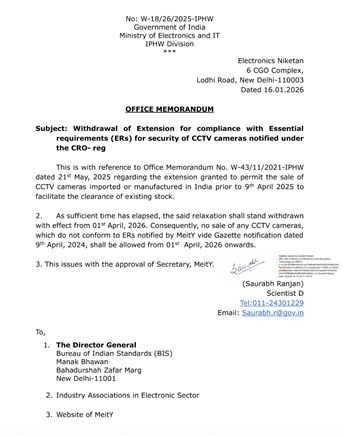
The key document being referenced, and arguably misrepresented, is the Office Memorandum issued by the Ministry of Electronics and IT (MeitY), IPHW Division, dated January 16, 2026 (Communication No: W-18/26/2025-IPHW). This memorandum does not introduce a new ban, but rather announces the withdrawal of a previously granted extension, as also reported by SECURITY UPDATE on Jan 19, 2026.
 To understand the context, one must go back to an earlier Office Memorandum dated May 21, 2025. At that time, the government had granted a temporary relaxation allowing the sale of CCTV cameras, imported or domestically manufactured, without ER compliance, specifically to help companies clear existing inventory that predated April 9, 2025.
The January 2026 memorandum simply states that “as sufficient time has elapsed,” this relaxation stands withdrawn effective April 1, 2026. Consequently, from this date onward, no CCTV cameras that do not comply with the notified Essential Requirements (as per the April 9, 2024 Gazette notification) can be sold in India.
This is a compliance enforcement measure, not a geopolitical or country-specific ban.
Adding further clarity to the situation, an industry communication circulated by Prama Hikvision India Private Limited, titled “Clarification on Unverified and Fake News Being Published in Media About CCTV Companies in India”, directly addresses the confusion. The company categorically states that reports suggesting Chinese CCTV companies are not allowed to sell in India from April 1, 2026 are “unverified, incorrect and false.”
The clarification also highlights an important nuance often overlooked in media coverage: STQC certification is currently mandatory only for IP cameras, and lack of such certification does not amount to a blanket ban on companies or all their product categories. In fact, a wide range of security and surveillance products, including HD/analog cameras, DVRs/NVRs, video door phones, access control systems, intrusion alarms, body-worn cameras, dashcams, and storage devices, are not covered under this specific certification requirement.
This reinforces the point that the regulatory framework is targeted and technical, rather than sweeping or exclusionary.
The confusion, and subsequent sensational headlines, appear to arise from the practical implications of these compliance requirements. Some global manufacturers, including Chinese brands, may be facing challenges in obtaining the necessary certifications under India’s evolving regulatory regime. This may temporarily impact their ability to sell certain product lines, particularly IP-based surveillance systems. However, this is a market access issue linked to compliance, not a policy-driven ban.
What is concerning is how legacy regulatory decisions are being reframed into breaking news narratives, creating unnecessary alarm among stakeholders, especially system integrators, distributors, and end users.
Such reporting risks distorting market perception, influencing procurement decisions, and disrupting business continuity in an industry already navigating regulatory transition.
The takeaway is clear:
April 1, 2026 does not mark the beginning of a ban, it marks the end of a grace period.
For the industry, the message is not exclusion, but adaptation. Compliance with ER norms and certification requirements is now non-negotiable. Companies, Indian and foreign alike, must align with these standards to continue operating in the Indian market.
In an environment where regulatory tightening is inevitable, clarity, not conjecture, must guide both reporting and decision-making.
What is unfolding in the CCTV domain is not an isolated case, it is part of a larger and increasingly visible pattern of how misinformation and disinformation are used to construct narratives that do not fully exist in reality. Even in ongoing geopolitical conflicts such as the U.S.–Iran tensions, analysts have observed a parallel “information war,” where competing sides, and sometimes even non-state actors, shape perception through selective facts, AI-generated visuals, and amplified half-truths. Reports indicate that false or manipulated content, including deepfakes and recycled war footage, often spreads significantly faster than verified information, creating confusion and influencing public opinion before facts can catch up.
In such environments, real policy actions are frequently exaggerated, reframed, or taken out of context to fit a larger narrative. The current discourse around CCTV regulations in India reflects a similar phenomenon, where a technical compliance enforcement measure is being projected as a sweeping geopolitical ban, reinforcing how easily perception can be shaped when information is consumed without sufficient scrutiny.