


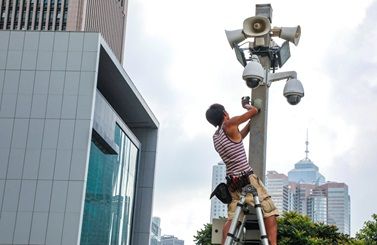
Hong Kong police will incorporate facial recognition technology into their surveillance cameras as early as the end of this year, enabling officers to identify suspects and missing people in real time, the force has revealed.
Senior Superintendent Eric Leung Ming-leung said that from the end of July, the force would also expand its “SmartView” surveillance camera installation programme to mobile cameras installed on 60 patrol cars that would be able to identify vehicles and licence plates. “We will see if it’s possible to use facial recognition in our SmartView systems by the end of this year,” Leung, of the force’s operations wing, revealed.
Police launched the SmartView project in April last year after conducting a pilot scheme to install 15 sets of cameras in Mong Kok in March. As of Wednesday, the force had installed 3,162 cameras across the city.
Leung said the force aimed to install no fewer than 2,000 sets of surveillance cameras each year from 2025 to 2027. These roughly 6,000 sets, containing more than 15,000 individual cameras, would be installed across Hong Kong by the end of 2027. He said police would install the cameras on road signs and traffic lights, and also erect pillars for more sets this year.
He added that the force would need to finalise how its back-end system would support facial recognition functions for the advanced technology to be deployed in surveillance cameras.
“When we are installing cameras, many are already equipped with this function, but we need to upgrade our system to coordinate the work. This requires time,” Leung said.
While Leung did not disclose how many would contain facial recognition technology, he said their height and the foot traffic flow of the locations were factors the force would consider when installing such cameras.
Facial recognition would be used mainly in two ways, Leung said. One was for investigation purposes, to identify suspects or missing people from surveillance footage, while the other was for detection.
“If you have identified the face and features of a suspicious or missing person. You can key that [selected] area into the back-end system, and then ask the system whether these features have been captured by these cameras,” Leung said.
The force could also programme its surveillance camera system to alert officers when suspects or missing people whose facial identities had been entered into the system were detected. “[We] can ask the system if any cameras have captured the [relevant] people, and then alert our investigating officers. Then, we could respond to that,” Leung said, describing this function as “instantaneous”.
Before facial recognition was tried out across police cameras, Leung said, the force would introduce mobile surveillance camera systems through two sets installed atop patrol cars.
These cameras would be positioned at the left front and right rear positions on top of the cars, and would be equipped with a feature to identify licence plates. Sample footage taken by the mobile cameras displayed road conditions with a clear view of passing vehicles and their licence plates. The force added that surveillance cameras would blur surrounding buildings to comply with privacy requirements.