


The new Labour Codes turn ‘Guard Welfare’ into a Client Responsibility, and not a Contractor Problem.
In a historic move, the Government of India has announced the implementation of the four Labour Codes – the Code on Wages, 2019; the Industrial Relations Code, 2020; the Code on Social Security, 2020; and the Occupational Safety, Health and Working Conditions Code, 2020, which came into effect on 21 November 2025. Together, these Codes consolidate and rationalise 29 existing labour laws, marking one of the most significant reforms of India’s labour framework in decades.
Through this article, SECURITY TODAY seeks to assess the current state of the manned guarding industry and examine the changes likely to emerge as a result of these reforms. Given that the impact of the four Labour Codes is still unfolding, with states aligning their regulations and framing detailed rules, the true implications for the manned guarding sector are only beginning to take shape.
For decades, India’s Private Security Industry (PSI) has expanded rapidly, but unevenly. What began as a largely informal manpower solution has grown into a vast national workforce guarding offices, factories, campuses, infrastructure, and residential communities, making it one of the country’s most significant employment generators. Today, the PSI is widely recognised as India’s second-largest employer, providing livelihoods to over nine million people and serving as an essential, if often invisible, backbone of commerce and public safety.
However, this scale has not been matched by a corresponding evolution in governance or professional maturity. For much of its history, the sector has operated within a fragmented regulatory environment, dominated by thousands of small and mid-sized agencies alongside a limited number of organised national, and even multinational, players. Competition in this landscape has been driven overwhelmingly by price, with business models built more on manpower aggregation than on structured processes, technology adoption, or rigorous compliance.
As a result, growth has been volume-led rather than value-led, reinforcing informality and diluting accountability across large parts of the industry.
Online research indicates that, as of early 2025, India had over 26,000 licensed private security agencies operating under the Private Security Agencies (Regulation) Act (PSARA), 2005. Maharashtra leads the count with more than 7,200 licensed agencies, followed by Gujarat, Karnataka, and Uttar Pradesh. Together, these agencies employ over five million security guards, underscoring the sheer scale and importance of this rapidly growing sector.
Alongside the licensed ecosystem, however, thousands of private security agencies continue to operate without licences, employing an estimated couple of million additional guards in the unorganised sector. This significantly expands the size of the industry while simultaneously distorting the market. While large, organised agencies generally ensure statutory compliance and employee welfare, many mid-tier agencies struggle to do so, not out of intent, but compulsion.
This pressure is driven by unethical competition from unlicensed operators and, at times, even from large agencies that operate at scale and leverage technology to reduce operational costs and aggressively capture market share. Clients also contribute to the problem by delaying payments, withholding dues, or imposing penalties, which severely strains the cash flows of mid-sized agencies. These financial pressures often result in defaults on statutory obligations such as EPF, ESI, and GST among others.
Caught between unfair competition and delayed client payments, thousands of mid-level agencies find it increasingly difficult to operate profitably. Ultimately, it is the security guards employed by these agencies who bear the brunt of this systemic stress. In contrast, agencies that continue to “fly under the radar” do so by deliberate choice; an approach that is outright criminal, marked by the exploitation of guards and the short-changing of clients.
 This structure has quietly encouraged a “compliance-lite” operating culture. Statutory obligations, minimum wages, overtime, weekly offs, provident fund, ESI, gratuity, training, and welfare were too often treated as negotiable line items rather than non-negotiable legal costs. Lowest-bidder contracting has become the norm, and economic pressure flows downhill, landing squarely on the guard. Extended shifts, delayed payments, partial social security coverage, and informal employment arrangements have become normalised practices rather than exceptions.
More than two decades after the notification of the PSAR Act, enforcement remains inconsistent and challenging. As a state subject, its implementation has often suffered from a lack of political and administrative will. There is an urgent need for authorities to crack down on illegal security agencies to provide much-needed breathing space for compliant mid-level operators, many of whom are entrepreneurs and former armed forces personnel committed to building sustainable manned guarding businesses and contributing to national economy and national security.
The new Labour Codes turn Guard Welfare into a Client Responsibility, and not a Contractor Problem.
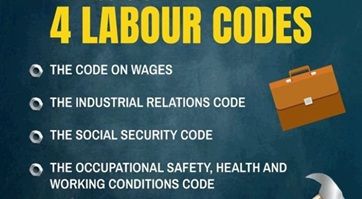 Since 2014, the government has repealed or amended 1,577 old laws, of which 1,562 have been repealed outright and 15 re-enacted in updated form with the objectives of improving “ease of living” alongside the government’s focus on ‘ease of doing business’. Now, In a historic decision, the Government of India has announced the implementation of
the four Labour Codes which came into effect from 21st November 2025, rationalising 29 existing labour laws.
The four Labour Codes – The Code on Wages, 2019, The Industrial Relations Code, 2020, The Code on Social Security, 2020, and The Occupational Safety, Health and Working Conditions Code, 2020 have implications for Security Agencies, their Employees (Guards etc) and also their Clients (End Users), apart from society at large
In the biggest overhaul of workers’ laws, these reforms are marked as the most major and comprehensive since Independence. At the center of these changes is a renewed emphasis on the financial security of over 40 crore workers, particularly through rules governing timely payment of wages.
Under the new labour reforms, the industry is now facing major changes to employment rules. A key feature of these reforms is that fixed-term employees should now receive the same benefits as permanent employees for the duration of their contract, including provident fund, ESIC, insurance, and other social security entitlements.
India’s New Labour Reforms: The rule for Timely Wages
The Code on Wages, 2019, is one of the key reforms. As per announcements, it establishes a uniform definition of wages and guarantees a minimum wage for all workers, including those in the unorganised and gig sectors. Importantly, it mandates employers to pay wages without delay, thereby protecting employees earning up to Rs 24,000 per month. Notably, violations will now incur strict penalties, including penalties and interest on delayed payments, which can be claimed through a centralised online portal.
A notification said, “Under the Code on Wages, 2019, all workers have the statutory right to receive a minimum wage payment. Minimum wages and timely payment will ensure financial security. Employers must provide all workers above the age of 40 years with a free annual health check-up.”
India’s New Labour Reforms: Key changes
Minimum National Floor Wage
 The Code on Wages, 2019, mandates a National Floor Wage (NFW) threshold, which is a statutory baseline wage level fixed by the Central Government below which no minimum wage can be set anywhere in India. It is not the wage paid directly to workers. It is a benchmark or floor that guides States while fixing their minimum wages. States cannot notify minimum wages lower than the National Floor Wage, irrespective of sector, skill category, or geography.
In simple terms: The National Floor Wage is the lowest legally acceptable minimum wage in the country.
Earlier, minimum wages applied only to scheduled industries/employments, leaving many workers uncovered. Now, all workers are entitled to statutory national minimum wage payment under the Code on Wages, 2019, ensuring financial security.
For guarding agencies and their clients, the National Floor Wage is likely to have direct commercial implications, it will curb wage arbitrage between states and regions, it shall limit the ability of agencies to quote unrealistically low manpower costs, it strengthens wage predictability for contract pricing and long-term service agreements. It will reduce exploitation of guards deployed in lower-wage states or remote locations.
The 50% Wage Rule
By mandating that Basic wages and DA form a minimum of 50% of total CTC, the Labour Codes upend long-standing salary structuring practices. For guarding agencies, this is nothing short of a financial reset, sharply increasing exposure to Provident Fund and gratuity liabilities.
Timely Salary
 Earlier, it was not mandatory for employers to pay wages on time. But now employers must provide timely wages, ensuring financial stability, reducing work stress, and boosting overall morale.
Now, salary accruing to employees for the month must now be paid by the 7th day of the succeeding month. These reforms aim to bring greater transparency to salary payments, requiring companies to pay employees by the 7th of each month. This is expected to increase trust between workers and employers and reduce financial stress.
Enhanced Social Security Inclusion
The Social Security Code, 2020, broadens the safety net by extending Provident Fund, ESIC, and gratuity coverage to fixed-term and contract workers. For security guards, the shift is especially consequential: gratuity eligibility now begins after just one year of service, replacing the long-standing five-year threshold.
Preventive Healthcare
 Earlier: There was no statutory obligation on employers to provide free, periodic health check-ups for workers.
Now: The new Labour Codes mandate employers to provide free annual health check-ups for workers above the age of 40, encouraging a shift from reactive treatment to preventive healthcare.
Why this matters for security guards:
Security personnel are frequently deployed in hazard-prone locations—industrial plants, construction sites, infrastructure projects, high-traffic public spaces, and night shifts, where prolonged standing, exposure to pollution, stress, irregular sleep cycles, and physical strain are routine. Regular health screenings enable early detection of cardiovascular issues, respiratory ailments, vision problems, and fatigue-related conditions, reducing the risk of on-duty medical emergencies and improving long-term occupational safety.
For guards, this provision is not merely a welfare measure, it is a critical safety intervention that supports fitness for duty, enhances resilience in demanding environments, and affirms their role as frontline protectors rather than expendable manpower.
“Harder to Shut Down”: What the 300-Employee Threshold Means for Guarding Agencies
Overall, for Private Security Agencies, the 2025 Labour Codes represent far more than a routine legal update, they signal a structural reset of the industry’s operating model. Measures such as the standardised 50% wage-to-allowance rule and the universalisation of social security coverage through PF and ESIC dismantle long-standing arbitrage practices, creating a more level and transparent competitive landscape. In doing so, they penalise fly-by-night operators and reward agencies that have invested in compliance, governance, and ethical employment practices. As the Private Security Industry transitions to a Compliance-First Regulatory Model and automation of its processes and filings, operational discipline, technology-enabled workforce management, and rigorous payroll auditing will no longer be optional, they will define credibility and survival.
Equally important, the true measure of success of the 2025 Labour Codes lies in the restoration of dignity to security work. By extending fixed-term employment protections and social security benefits to contract, gig, and previously unorganised segments of the PSI, the reforms address one of the industry’s deepest and most persistent fault lines, the vulnerability of its frontline personnel. Timely wage payments, predictable working hours, access to healthcare, and enforceable occupational safety norms collectively redefine what it means to be employed as a security guard in India.
Together, these initiatives have the potential to transform guarding from a precarious, transient job into a stable and respectable career pathway. If implemented and enforced in both letter and spirit, the 2025 Labour Codes position the Private Security Industry to emerge as a benchmark for how large, labour-intensive sectors can balance commercial viability with comprehensive workforce welfare, without compromising on professionalism, accountability, or trust.
A professionalised security workforce will not only safeguard assets more effectively, but also play a critical role in plugging economic leakages and reinforcing the nation’s broader security architecture.
Implementation of labour codes: What changes and road ahead
Labour Codes drive a transformative shift–simplifying compliance, strengthening welfare, and aligning India with global standards
Some key provisions that now take effect are:
Wage and compensation reforms
The Codes introduce a standardised definition of “wages,” replacing the multiple definitions and interpretations under previous laws. This impacts calculations for benefits such as provident fund, gratuity, leave encashment, statutory bonus, overtime etc.
Leave encashment over 30 days of carry forward leave is mandated, on demand from the employee. Work hours have been defined and overtime is now payable to workers over the standard work hours, while specific rules are awaited.
Minimum wages now apply to all employees. Additionally, a national “floor wage” will be notified by the Central Government, ensuring that States do not prescribe minimum wages below this level. These measures aim to simplify compliance and guarantee a baseline income for workers across the country.
Employers are now obligated to ensure timely payment of wages. In cases of termination, whether due to removal, retrenchment, dismissal, or resignation, wages must be paid within two working days. This provision enhances financial security for workers.
Social security and health benefits
Gratuity benefits have been extended to fixed-term employees who complete one year of service as compared to the five-year requirement for full-time employees. Importantly, gratuity will now be calculated based on the revised wage definition, potentially leading to retroactive financial implications for employers.
It may be noted that as an exception, the existing Employee Provident Funds and Miscellaneous Provisions Act (EPF), 1952 has however not yet been repealed. As a result, the existing EPF Act and its provisions continue to remain in force till notified otherwise.
Employees’ State Insurance (ESIC) coverage has been broadened to include establishments with fewer than ten employees on a voluntary basis. Coverage is however mandatory for industries engaged in hazardous industries, regardless of workforce size. These will help extend health and social security benefits to smaller businesses.
Employers are also required to provide free annual health check-ups for workers above a specified age, creche facilities etc. constitute safety committees in certain cases, reinforcing the focus on worker well-being.
Workforce planning
Social security coverage has now been extended to gig and platform workers, formally recognising their role in the economy, while detailed benefits in this regard are yet to be notified.
There are revised definitions of contract labour and a prohibition to engage contract labour in core activities of a business, subject to exceptions. Also, the wages/ benefits to them have been aligned with permanent employees, while making the principal employer liable for wages, benefits etc.
The threshold for requiring government approval for lay-offs, retrenchments, or closure of establishments has been raised from 100 workers to 300 workers. This change provides greater operational flexibility for employers while maintaining oversight for larger establishments.
The classification of individuals as either employees or workers, which determines their rights, entitlements, and obligations is now of paramount importance.
Employment formalisation and inclusivity
The Codes mandate issuance of appointment letters to all employees with specified details, including those in informal roles, thereby formalising employment relationships.
Women can now work in all establishments and during night shifts, subject to consent and safety measures. This change promotes gender equality and inclusion, removing previous restrictions on women’s employment in certain sectors.
Transition challenges
While the Codes are effective 21 November 2025, final Central and State rules are yet to be notified, which may clarify aspects such as such as minimum wages, threshold for statutory bonus, gratuity limits, working hours and overtime. Until then, existing rules and regulations will continue, provided they do not conflict with the Codes. Informal sources have indicated that draft rules will be pre-published shortly, with a 45-day public consultation window–a critical opportunity for stakeholders to shape a clear compliance framework and minimise future litigation.
In the meanwhile, this transition period presents its own set of challenges. This overlap and interplay of Central and State rules may create some confusion among employers regarding which provisions to comply with. The industry also awaits clarification and guidance on some critical aspects such as interpretation of the wage definition which is the basis for calculating all statutory benefits and coverage. Clear guidance on transitional provisions will be essential to avoid inadvertent non-compliance and penalties.
What organisations should do
To navigate this complexity, organisations must undertake a thorough analysis of the impact of the new codes on their operations. They should review wage structures, financial impact, manpower arrangements, and existing compliance processes. They should carry out a review of their HR processes and policies etc. to come to a state of readiness.
Despite the inevitable transitional challenges that accompany reforms of this magnitude, the Labour Codes mark a progressive and transformative shift – simplifying compliance, strengthening worker welfare, cultivating inclusivity and aligning India’s labour framework with global standards. The success however will hinge on seamless implementation, harmonised rules and a shared commitment between the policy makers and industry to build a fair and sustainable employment ecosystem.
The author is Partner and National Head – Tax, Global Mobility Services of KPMG in India