


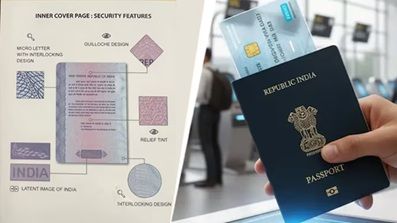
In a major upgrade to its passport system, India is set to roll out next-generation e-passports equipped with cutting-edge security features, including interlocking microletters, relief tints, and embedded RFID chips storing encrypted biometric data, and more, according to design details revealed.
Under the rollout, all newly issued passports will immediately be e-passports, while existing non-electronic passports will remain valid until their expiry. The government plans a full transition to e-passports by June 2035.
Each e-passport is embedded with a Radio Frequency Identification (RFID) chip and antenna that securely store encrypted biometric and personal data, such as photographs and fingerprints, in a digitally signed format compliant with International Civil Aviation Organisation (ICAO) standards.
The contactless data-reading capability of these chips enables faster and more reliable identity verification at immigration counters, significantly reducing fraud, tampering, and wear-and-tear. So far, the MEA has issued 80 lakh e-passports domestically and over 60,000 through Indian missions abroad.
The RFID chip securely stores the passport holder’s biometric and personal information, including photographs, fingerprints, and other personal details, in encrypted form. This digital layer allows for faster and more reliable authentication at immigration counters, significantly reducing the risks of fraud and forgery. The antenna enables contactless data reading, enhancing durability by minimising physical handling.
Senior MEA officials said the revamped system will drastically reduce passport fraud and prevent cases of individuals holding multiple passports. The new system verifies an applicant’s biometric data against a central server, immediately flagging any existing passport in the applicant’s name.
Implemented in May 2025, the Passport Seva Programme Version 2.0 (PSP V2.0) is now operational across 37 Regional Passport Offices (RPOs), 93 Passport Seva Kendras (PSKs), and 451 Post Office Passport Seva Kendras (POPSKs). The global version of the programme, GPSP V2.0, launched on October 28, 2025, is designed to enhance passport services at Indian missions abroad.
The revamped system integrates AI-driven chat and voice bots for application assistance and grievance redressal, online document uploads, auto-filled forms, and UPI/QR-based payments. Advanced biometric and facial recognition systems, AI-based alerts, and data analytics further strengthen security and efficiency. The system is also integrated with DigiLocker, Aadhaar, and PAN for seamless document verification.
Additional features include Robotic Process Automation (RPA) for document validation, touchscreen feedback, electronic signature pads, and real-time MIS dashboards. A National Call Centre, operating in 17 languages, provides citizen support. Three state-of-the-art data centres in Noida, Chennai, and Bengaluru anchor the upgraded infrastructure, ensuring robust security and threat management.