


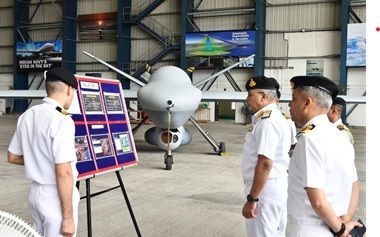
The Indian Coast Guard is in the process of inducting Remotely Piloted Aircraft and Unmanned Aerial Vehicles to enhance its surveillance, reconnaissance and intelligence gathering capabilities, Director General Paramesh Sivamani has said. In a recorded podcast, shared by the defence ministry online, he said the second phase of the Coastal Surveillance Network project is on the anvil and it should get operational “by the end of this year”.
Sivamani shared the evolution of the ICG, started in 1978, to an important force multiplier of the defence forces at present.
At its inception, two ships decommissioned from the Indian Navy were given to the Coast Guard. Now, the ICG has about 205 ships and crafts of various sizes, and 78 aircraft, which include both fixed-wing and rotary-wing ones, the DG said.
He also spoke of the recent back-to-back maritime disasters in the Indian waters, including the Singapore-flagged merchant vessel MV Wan Hai 503 catching fire in June, and the Liberian container vessel MSC ELSA 3 sinking off Kerala’s Kochi coast in May, and the rescue efforts made by the ICG
The ICG tried to ensure there was no damage to the maritime ecosystem, he said.
Asked how the ICG is strengthening itself to enhance its operational readiness, he said the force has ships and aircraft of various sizes and various capabilities.
“As a forward-looking coast guard, we are also inducting state-of-the-art ships with cutting-edge technology. Similarly for aircraft, which will be a force multiplier for us. We are also in the process of inducting RPAs and UAVs, which will enhance the surveillance and reconnaissance, and intelligence gathering for us over the maritime domain,” he said.
The ICG’s Coastal Surveillance Network – phase 1, at present, has “46 radar stations, which are fully operational”. “Phase 2 is also on the anvil, we have 38 radar stations , which should get operational by the end of this year,” he said.