



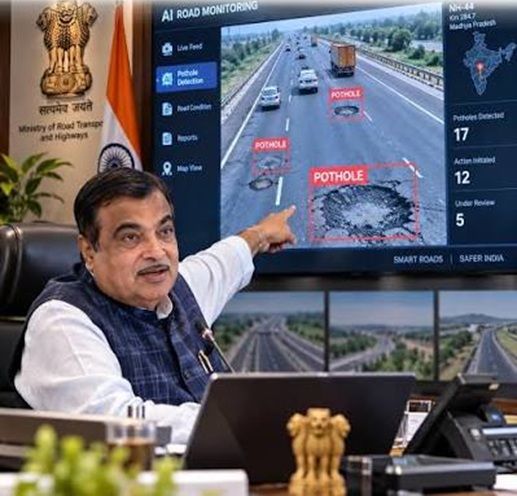
The Centre will use Network Surveillance Vehicles (NSVs) to identify potholes across national highways and hold contractors, consultants and officials accountable for poor road quality, road transport and highways minister Nitin Gadkari said, warning that those found compromising on quality would face penalties and blacklisting.
Speaking at the CII National Conference on Highways of India’s Future: Smart, Safe and Sustainable in New Delhi, Gadkari said the Ministry of Road Transport and Highways (MoRTH) had stepped up quality monitoring, helping reduce reported construction-quality problems by 30%.
“In the last few months, I have been personally monitoring this, and I have reviewed hundreds of projects. Social media posts have also been helpful in flagging quality issues at stretches, and I urge the public to put these problems on social media. We have already seen a drop of 30% in such problems since we started monitoring these closely and am reasonably sure we will see the rest resolving over the next two years,” the minister said.
NSVs are vehicle-mounted, multi-sensor platforms that assess road conditions and pavement quality at traffic speeds of 40–80 kmph. The ministry has mandated their use, with the National Highways Authority of India (NHAI) deploying them to monitor road quality, plan repairs and feed data into AI-based systems such as the RAMS Data Lake.
Gadkari said the ministry had already blacklisted several companies manufacturing bearings and expansion joints over quality concerns, adding that it was adopting a zero-tolerance approach to lapses.
The government is also expanding technology-led road safety measures. Gadkari said AI-based Advanced Traffic Management Systems would be deployed in the first phase across about 1,000 km of highways, with real-time tracking of every movement. He stressed the importance of lane discipline in reducing road accidents and reiterated the need to adopt alternatives and biofuels.
Gadkari said he was in talks with Bihar’s chief minister to sign a memorandum of understanding under which NHAI would dredge rivers free of cost and use the accumulated silt in highway construction. The initiative, he said, would significantly reduce Bihar’s flood risk.