

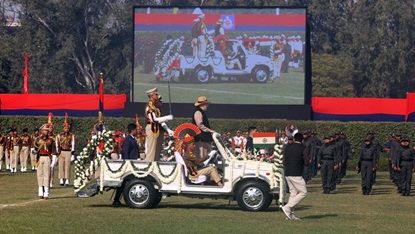
A decade after the Delhi Police had moved a proposal for the construction of a dedicated headquarters for its anti-terror unit, the Special Cell, Union Home Minister Amit Shah on Monday laid its digital foundation stone on the occasion of the force’s 79th Raising Day ceremony in the presence of Delhi Police Commissioner Satish Golcha, among others.
The construction is set to begin soon with the decade-long wait for the Delhi Police coming to an end, said officers. The multi-storey building, to be constructed at an estimated cost of Rs 368 crore, will be located at Lodhi Colony, where multiple anti-terror operations have been conducted over the past two decades.
As per the plan, the building will be blast proof with a safe house, and may also have a helipad on its roof. While speaking at the event, Shah said the headquarters will be equipped with a state-of-the-art indoor firing range, war room, cyber lab, training hall, and various modern facilities. It will serve as a “model Special Cell” headquarters for police forces across the country. “The Special Cell of Delhi Police has played a successful and significant role in investigating narcotics syndicates, fake Indian currency rackets, complex cybercrimes, organised crime, and several major terrorist incidents not only in Delhi but across the country,” he said.
The Special Cell has five different ranges and one Counter Intelligence unit (CI). Once the new headquarters is ready, senior officials of the Special Cell, including the Special Commissioner, will have their offices in the new building. Officers said that the existing office at Lodhi Colony will be razed to begin the construction of the new headquarters.
In another shot in the arm, Shah also launched the first phase of the Delhi Police’s Rs 857-crore ambitious Safe City project, and said it will significantly enhance Delhi’s security in the coming days. Under the project, a modern Integrated Command, Control, Communication and Computer Centre (C4I) has been set up, connected to 10,000 cameras.
Of these, 2,100 cameras have already gone live, and the integration of more than 15,000 existing cameras with the system has been completed. The project, which began in 2018, had its deadline extended multiple times. The installation of cameras began in the riot-affected Northeast district and was later expanded to cover the entire city. Once developed, the police control room (PCR) can receive information about any incident without the need for a PCR call — as the cameras will be equipped with features such as face recognition system and distress detection technologies, capable of identifying sounds and facial expressions associated with emergencies.