


The military junta has officially formed a Supervisory Committee for Private Security Services across all regions and states, including Rakhine State, where Chinese security personnel are currently present.
The formation of the Central Supervisory Committee, along with regional and state-level counterparts, was announced in the Myanmar Gazette on 20 and 27 June. These bodies are tasked with overseeing the licensing and regulation of private security companies and any businesses that employ private security personnel.
According to the Myanmar Gazette, the committees were formally established on 23 May and are chaired by the respective Ministers of Security and Border Affairs appointed by the junta. Each committee is composed of 14 members, including officials from Myanmar Posts and Telecommunications, the General Administration Department, the State Transport Planning Department, the Road Transport Administration Department, the relevant regional military command, and the state police force.
The move comes in the wake of a Chinese proposal to establish a China-Myanmar joint venture private security company. In response, the junta enacted the Private Security Services Law on 18 February 2025, which permits foreign nationals to be armed and operate in Myanmar’s private security sector. The law is currently being implemented in stages.
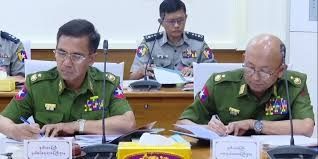
At a Central Supervisory Committee meeting held on 19 June in Naypyidaw, committee chair Lt-General Tun Tun Naung announced that an official directive for private security service license applications had been issued on 18 June.
Companies seeking to operate private security services must now apply for licenses through the relevant supervisory committees at the Union Territory, regional, or state level. This allows both local and foreign entities including Chinese firms to submit applications for operating private security services in Myanmar.
Following the enactment of the Private Security Services Law in February, the junta formed the Central Supervisory Committee in March, with regional and state-level committees following nearly two months later.