

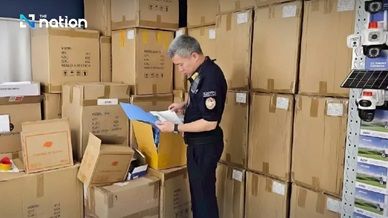
The Office of the National Broadcasting and Telecommunications Commission (NBTC) in Thailand, in collaboration with relevant agencies, arrested entrepreneurs for selling and installing unauthorised frequency-using CCTV cameras, or “illegal CCTV cameras,” in Soi Lat Phrao 101, Bang Kapi District, Bangkok.
Trairat Viriyasirikul, Deputy Secretary-General and Acting Secretary-General of the NBTC, assigned Chaturon Choksawat, Assistant Secretary-General of the NBTC, along with the “Phra Phai” special operations task force and officers from the Telecommunications Business Regulation Bureau, to carry out the NBTC’s inspection and monitoring of frequency usage.
It was discovered that several entrepreneurs had imported and sold CCTV cameras without permission to use the frequencies, and these devices had not passed the NBTC’s standard certification as required by law.
The on-site inspection revealed that the company owner is a Chinese national with a Thai caretaker. They were using a commercial building in Soi Lat Phrao 101 as a storage facility and for online sales.
During this operation, officers searched and seized 6,606 sets of illegal CCTV equipment for inspection, along with 501 foreign SIM cards linked to prepaid accounts via applications, with an estimated total value of THB10.5 million.
The Office of the NBTC has filed a formal complaint to prosecute the distributors and warehouse operators. They are liable under the Radiocommunications Act 1955 and its amendments, which carry a penalty of imprisonment not exceeding 5 years, a fine not exceeding THB100,000, or both.
They may also face charges under the Telecommunications Business Act 2001 if further investigation reveals they were operating a telecommunications business without authorisation.
Trairat stated that using unauthorised frequencies for illegal CCTV cameras is not only against the law but also causes signal interference with other telecommunications systems operating in the same frequency band, such as wireless internet (Wi-Fi), mobile phones, and government communication systems.
This could potentially affect the stability and security of the country. Furthermore, substandard equipment may contain data security vulnerabilities, increasing the risk of being hacked and allowing access to the personal data of homeowners or users.