

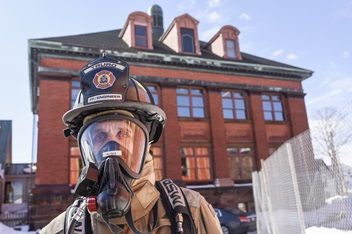
Nova Scotia, a Canadian province is investing in mobile live-fire training equipment to address safety and competency gaps across its largely volunteer fire service and rebuild its provincial training system following the loss of its long-time fire school.
The Department of Emergency Management will purchase two mobile burn units and four propane‑fuelled training props to expand access to hands-on, standardised training for firefighters across the province, the Nova Scotia government announced. The expenditure totals $2.64 million, including $2.16 million for the burn units – one new and one refurbished – and $480,000 for the training props.
Emergency Management Minister Kim Masland said the investment is designed to improve firefighter safety and public protection by making realistic training more accessible. “Firefighters need realistic, high-quality training to safely do their jobs and protect the public,” Masland said, adding that she has heard from “over 300 fire chiefs and deputies and our fire training advisory committee about the importance of access to mobile burn units.”
According to the provincial government, the two new mobile burn units will be based in the western and central regions, joining an existing unit in Cape Breton and bringing the provincial total to three. Each unit is a portable, self-contained trailer that allows firefighters to practise live‑fire scenarios in a controlled environment using propane‑fuelled fires, smoke and adjustable layouts that simulate real emergencies while meeting national safety standards.
The units can be moved and deployed as needed, enabling firefighters to train closer to home rather than travelling long distances or going without live‑fire practice. Masland said the units “help close training gaps and ensure firefighters across the province can train closer to home in a safe and controlled environment.”
To complement the burn units, the Department is purchasing four modular propane‑fuelled training props. These simulators can be configured to safely recreate multiple fire types, including propane tank and other pressure‑vessel incidents and fires with multiple ignition points.
The props will allow firefighters to practise core competencies such as hose handling, extinguisher use, shutting off fuel sources, cooling fires and making rapid decisions under pressure in a controlled scenario framework. The Nova Scotia government said the equipment will support more realistic training while maintaining a high degree of control over exposure to heat, smoke and other live‑fire hazards.
Mark Bettens, chief director of fire services for Cape Breton Regional Fire Service, highlighted the safety implications: “Access to consistent, high-quality training is critical to firefighter safety and effectiveness. These mobile burn units and training props will allow firefighters across Nova Scotia to train closer to home, using realistic scenarios that better prepare them for the emergencies they face.”
The announcement comes as Nova Scotia overhauls its firefighter training system following a series of governance and safety concerns. In August, the Province released a value‑for‑money audit of the Nova Scotia Firefighters School and ended its relationship with the school “because of concerns with safety, governance and other issues,” according to the Nova Scotia government.