


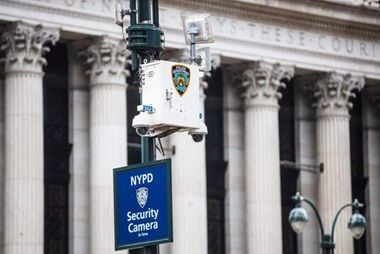
A new federal lawsuit accuses the New York City Police Department (NYPD) of operating an unconstitutional mass surveillance system that tracks residents and visitors across the five boroughs.
The 29-page complaint, filed October 27 in the Southern District of New York, alleges that the NYPD’s Domain Awareness System (DAS) fuses cameras, sensors, license-plate readers, biometric databases, and social-media monitoring into an integrated network that surveils millions of people without warrants or adequate oversight.
The plaintiffs, Brooklyn residents Pamela Wridt and Robert Sauve, argue that the system violates their First and Fourth Amendment rights by turning everyday life in New York into a continuous police search.
The suit, backed by the Surveillance Technology Oversight Project and the law firm Emery Celli Brinckerhoff Abady Ward & Maazel LLP, seeks to halt warrantless use of DAS and compel the city to adopt clear limits on data storage and access.
According to the complaint, the Domain Awareness System – developed by NYPD in partnership with Microsoft and expanded since about 2012 – consolidates more than a dozen surveillance technologies into a single interface.
The plaintiffs say it links video cameras, automated license-plate readers, drones, ShotSpotter gunshot detectors, biometric and facial-recognition systems, and social-media analytics, allowing officers to track individuals across space and time.
Wridt and Sauve claim the system’s reach extends directly into their home. Two NYPD cameras mounted outside their Bedford-Stuyvesant residence, they allege, are aimed through their living-room and bedroom windows.
The complaint describes DAS as a centralized platform integrating thousands of stationary and mobile cameras operated by both the NYPD and its private-sector partners. It cites public disclosures showing that video feeds flow into the system from other city agencies and private businesses, including housing-authority cameras.
Drones and helicopters, the plaintiffs say, supply additional live and archived footage of public areas. Police can view these feeds in real time or retrieve stored video for roughly 30 days, according to NYPD policy documents referenced in the lawsuit.
Automated license-plate readers record vehicles as they pass through checkpoints, capturing location, time, and images of drivers and passengers. The complaint asserts that NYPD pairs its database with records from private contractor Vigilant Solutions, which adds more than a million new plate scans each day, and alleges that plate data may be retained for years regardless of whether suspicion exists.
The plaintiffs also allege that NYPD’s ShotSpotter gunshot-detection microphones can pick up nearby conversations, including those occurring inside homes. The city has spent tens of millions of dollars on the system, though the lawsuit cites audit findings suggesting that a large share of alerts are false positives.
Another section of the complaint describes the department’s collection of biometric information, including fingerprints, facial images, and DNA. It points to an NYPD DNA database containing tens of thousands of profiles, some drawn from individuals never convicted of crimes.
The plaintiffs further allege that NYPD employs advanced analytic tools within DAS to connect disparate data points linking camera footage, location histories, and social-media activity to create detailed digital dossiers on individuals. According to the complaint, the system’s pattern-recognition software can follow a person across multiple cameras based on features such as clothing color or gait.