


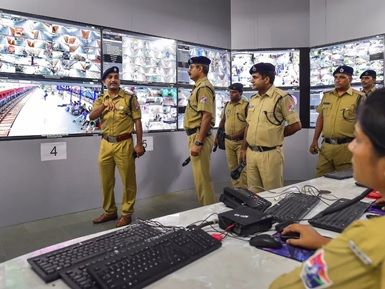
A nationwide audit of CCTV networks across major cities, including Delhi and Mumbai, after a spy ring was busted by the Ghaziabad Police, has exposed critical vulnerabilities in the country’s surveillance infrastructure.
Central agencies have asked all law enforcement agencies and police departments concerned to immediately review every camera installation under their jurisdiction in one of the most significant security directives in recent years.
The order comes after the unravelling of a Pakistan-linked espionage network that did not merely exploit existing cameras but installed its own covertly at sensitive locations, including Delhi Cantonment Railway Station and Sonipat Railway Station. The group fitted their own cameras with solar power systems to ensure round-the-clock, uninterrupted footage, which was allegedly relayed live to ISI-linked handlers across the border. Investigators say the network had tasked and funded plans to install more such panels in different cities.
Across the country’s major cities, thousands of CCTV units have accumulated over the years by government agencies, installed by a fragmented mix of municipal bodies, railway authorities, police departments and private contractors with inconsistent oversight, mismatched protocols and significant blind spots.
Central agencies have now asked all police forces to physically verify camera installations, identify any unauthorised or unregistered units, and assess whether existing networks have adequate access controls.
The audit is expected to cover not just sensitive zones such as cantonments and railway stations, but arterial routes and strategic corridors across major urban centres. The broader goal is to ensure no camera operates outside the knowledge and oversight of security authorities, a baseline that, until now, was never formally enforced.
The nationwide review goes well beyond a routine inspection. Authorities want a full physical verification of every CCTV unit, registered or otherwise, operating across sensitive urban zones. Police departments have been asked to map all installations, cross-check them against official records and flag any camera that cannot be accounted for.
Special attention is being paid to railway stations, cantonment areas, highways and routes with known military movement. Access controls on existing networks are also being reviewed, ensuring that live feeds cannot be intercepted or rerouted by unauthorised parties. Officials say the audit is also expected to establish a standardised national protocol for surveillance oversight, something that has been absent until now.