

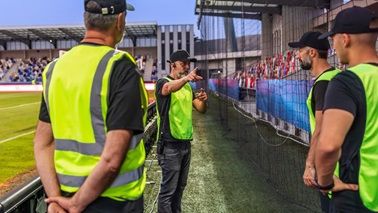
More than half of Australia’s national security mix is made up of private security personnel. They’re a 200,000+ strong team of people who do everything from checking your luggage at the airport, to guarding office buildings, managing crowded places, monitoring alarms and CCTV systems, to designing and installing electronic security systems, or working in a support service.
But new research shows the industry is in urgent need of structural reform if it is to have the capability and capacity to meet the future security needs of Australia. Security 2030, a new report commissioned by the Australian Security Industry Association Limited (ASIAL) – completed by the Security and Intelligence Research Group at Edith Cowan University – has identified key gaps in our security mix.
These gaps range from a lack of national professional standards, workforce shortages to lowest cost procurement practices. Researcher Dr Warren Doudle said it’s critical to address these gaps at a national level.
“It’s always been very urgent, but with major upcoming sporting events, Australia has to address (structural change within private security) urgently,” he said. “Even now, we’re going to be behind the curve, but it’s something we need to aggressively pursue.”
Chief Investigator Dr Nicola Lockhart agreed, saying the report is really a jumping off point to help us learn where our vulnerabilities are, and how we can improve. “The private security industry actually represents 54 per cent of the frontline response, which is more than the military and the police combined,” Dr Lockhart said.
“When you look at that hand-in hand-with the changing threat environment and the rapid escalation of technology, you find the private security industry is at the forefront of a significantly increasing number of situations,” she said. A key change the report calls for is the introduction of nationally consistent regulatory standards for the private security industry.
Regulatory inconsistencies between jurisdictions not only creates inherent vulnerabilities but also impacts workforce mobility, which is a huge problem when it comes to major events.
ASIAL CEO Bryan de Caires has been pushing for this change for many years, and said it is absolutely critical now.
“In some major events we need about 10,000 to 15,000 security personnel, plus significant electronic and physical security,” he said. Without the ability to move staff from state-to-state, Mr de Caires said it’s possible there simply won’t be enough qualified people available.
“A national agreement across all jurisdictions would be a fundamental game changer,” he added. “We need a national standard which sets the acceptable entry level benchmark for security operatives – whether that’s a consultant, security officer, or security technician.”
Compounding the issue is the current demographic of many security professionals around Australia.
“Nearly all the current generation of security leaders are retiring soon,” Dr Doudle said.
He explained that many promising leaders (for example, top graduates) are choosing to work in government roles rather than private security.