


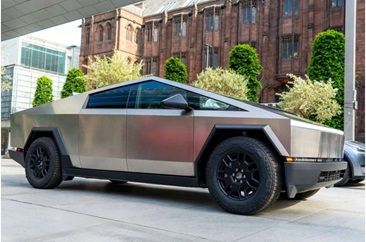
Hackers could exploit wireless systems in Tesla’s Model 3 and Cybertruck to track vehicles, disrupt communications, and interfere with network performance, according to research from Northeastern University posted to the arXiv preprint server. The study highlights the broader security risks facing all modern connected cars, which have increasingly become “computers on wheels.”
They feature cellular and Wi-Fi modems for continuous connectivity, GPS for navigation, Bluetooth antennas for connecting your phone, and a host of “vehicle-to-everything” (V2X) technologies to support safety features. And just like a smartphone or nearly any internet-connected device, these vehicles are susceptible to attacks.
Yet unlike smartphones, which allow users to download apps to track rogue activity or disable networks manually, many cars on the road today “maintain persistent” connectivity “to support remote diagnostics, OTA updates and application communications,” according to the researchers.
“The most important takeaway for someone buying a car is understanding that modern vehicles are always-on networked devices that you cannot control or monitor,” said Aanjhan Ranganathan, a Northeastern professor in the Khoury College of Computer Science.
He conducted the study on the Tesla vehicles’ Fourth Generation Long Term Evolution, or 4G LTE, connectivity in collaboration with Evangelos Bitsikas and Jason Veara, cybersecurity and privacy doctoral students at Northeastern.
One major way hackers can infiltrate the Tesla vehicles is through a process known as IMSI catching, the researchers uncovered. IMSI stands for International Mobile Subscriber Identity. Every subscriber connected to a network is given a unique IMSI number used to identify and authenticate them on that network.
While IMSI numbers often can’t be seen while connected online—Temporary Mobile Subscriber Identities are used in their place—there are instances when they could be caught by hackers. This could include when devices are first brought online or need to reattach to a network, the researchers write.
Hackers can use “IMSI catchers,” devices that mimic cell towers, to connect to a vehicle and track its location, said Bitsikas. “Any system that uses a cellular modem can be placed in situations where a nearby ‘fake tower’ can influence how it connects, especially if the attacker is physically close,” said Bitsikas.
Hackers can also use fake cellular towers to control a vehicle’s connectivity, prevent a car from connecting to the internet at all, intercept data traffic, and force a vehicle into “less secure” modes of operation.
“Importantly, this doesn’t automatically mean ‘remote control of the car,” but it can impact communications and privacy (e.g., backend communication with Tesla servers),” said Bitsikas.