


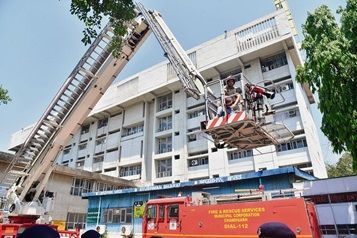
Penalties for fire safety violations in the city have gone up several times under the Haryana Fire and Emergency Services Act, 2022, extended to the Union Territory by the Union Home Ministry.
Fines set at Rs 10,000 under multiple sections have now gone up to Rs 1 lakh. The penalty under Section 25, for drawing water without authorisation during firefighting operations, rises from Rs 50,000 to Rs 2 lakh. Fees under Section 26, levied for non-appointment of a fire safety officer, move from a range of Rs 10 to Rs 50 per square metre to Rs 100 to Rs 200 per square metre.
Offences under Sections 29, 30 and 31, covering false fire reports, general contravention of the Act and offences by companies, earlier carried imprisonment up to three months, a fine up to Rs 10,000, or both, with a further daily fine for continuing offences. Under the extended Act, these carry only a monetary penalty, up to Rs 1 lakh, imposed directly by the Chief Fire Officer or an officer authorised by him, which doubles for a repeat violation.
Prosecution before a magistrate is replaced by an administrative penalty in these cases. The notification, issued under Section 87 of the Punjab Reorganisation Act, 1966, replaces the Delhi Fire Prevention and Fire Safety Act, 1986, which had governed fire safety in Chandigarh until now, and applies the Haryana law with 40 modifications suited to the Union Territory’s administrative structure.
Under the extended Act, the Municipal Corporation becomes the sole local authority recognised under the Act, and references to the Haryana Municipal Act, 1973, are replaced with the Punjab Municipal Corporation Law (Extension to Chandigarh) Act, 1994.
Fire safety certificate validity has also changed. Under the Haryana Act as it stood, certificates for high-rises and special buildings were valid for three years, and for residential buildings above 16.5 metres for five years. Under the extended Act, all covered buildings will have a uniform five-year validity, for both fresh certificates and renewals. The annual self-declaration by owners under Section 19(6) is replaced with a requirement to furnish an annual certificate issued by a licensed agency.
A new Section 55A introduces a licensing regime for private fire safety agencies. Any person or entity may apply to the Commissioner for a licence to carry out fire prevention and life safety work, valid for two years and renewable. The Commissioner has the power to suspend or cancel a licence after a hearing.
Fire tax provisions under Sections 39 and 40 are now linked to the Punjab Municipal Corporation Act, 1994, as extended to Chandigarh, in place of the earlier reference to property tax under any local authority in Haryana. Provisions removing the status of a civil court decree of compensation orders under Section 27, and aligning the definition of public servant with the Bharatiya Nyaya Sanhita in place of the Indian Penal Code, are also part of the modifications.
Rules under the extended Act are being framed by the Chandigarh Administration. Municipal Corporation officials cite the pending rules for delays in issuing and renewing no objection certificates and fire safety certificates for institutions and cooperative house building societies in the city.