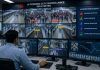


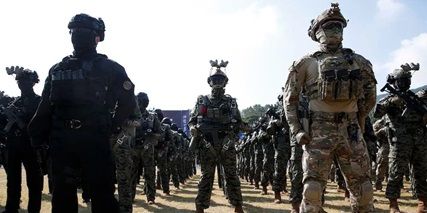
Civilians could soon stand guard where South Korean soldiers once did, as the Lee Jae Myung administration is trying to outsource guard duties for military bases in rear areas to private security companies.
The proposed plan comes as South Korea is facing a manpower shortage against the backdrop of a declining population and low birthrate. The South Korean military, as of this year, has around 450,000 active-duty members, short of the 500,000 deemed necessary for wartime mobilization. The Ministry of National Defense confirmed to the Korea JoongAng Daily that the ministry hired researchers to study whether private companies could take over rear-area security duties.
Rear areas are non-frontline regions that are away from the heavily fortified inter-Korean border such as parts of southern Gyeonggi, and the Chungcheong or Gyeongsang regions.
“The plan will not be implemented next year, but we will run a pilot program,” a Defense Ministry official from its spokesperson’s office said on Tuesday. “We plan to complete this program by 2040.” The initiative could come with a set of security issues or create confusion in the military, despite possibly resolving the personnel shortage problem for the armed forces.
A threat to South Korea’s military bases may not come from outside — but from the people hired to guard them. If private companies take over guard duties, they will need access to sensitive information — including military personnel data, restricted area locations, entrants’ names and vehicle details — to verify authorized personnel at the gates and confirm they are cleared for entry, particularly when the automatic ID scanning system is down.
Leaving these duties to private companies, however, could put the military at risk of exposing classified information. “Civilian workers need to know who holds what title, which is all security-related information,” Yang Uk, a research fellow from the center for foreign policy and national security department of the Asian Institute for Policy Studies, told the Korea JoongAng Daily. “Leaking that information to outside sources could be a problem. The biggest problem is to what extent can the military trust private companies.”
Although the Defense Ministry said private firms will only be in charge of noncombat guard duties such as identifying personnel and vehicles entering bases or managing CCTV systems, this would still require the military to share its information with civilian workers.
Data on military personnel and equipment is classified, as such information could allow outside actors to infer the combat capabilities of certain bases or their operational plans.
The move to replace soldiers with manpower provided by private firms aligns with an initiative unveiled by Defense Minister Ahn Gyu-back last October, which entails maintaining an active-duty force of 350,000 troops focused on combat roles while outsourcing noncombat functions, such as guard duties, to 150,000 civilian personnel.