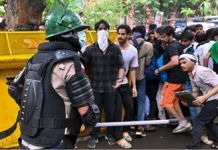


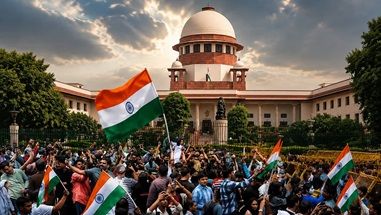
The Supreme Court has agreed to consider a petition challenging the use of facial recognition technology and other biometric surveillance by police at protest locations. The bench, comprising Chief Justice of India Surya Kant and Justices Joymalya Bagchi and V Mohana, has tagged the petition with others pending in relation to recent student protests organised by the Cockroach Janata Party (CJP).
The petition, filed by CPI (M) Rajya Sabha MP AA Rahim from Kerala, alleges that police surveillance included facial mapping and vehicle-mounted technology, with data collected from individuals without their consent and subsequently hosted by two private companies.
Senior advocate Menaka Guruswamy, representing Rahim, stated that spectacles were used for facial mapping and a surveillance vehicle for data gathering, asserting the data was taken without consent and hosted by private entities, contravening the Digital Personal Data Protection Act, 2023.
The plea arose from the Delhi Police’s purported use of digital surveillance tools to monitor protesters at Jantar Mantar. The court agreed to examine the matter.
The petition claims that the Delhi Police conducted biometric surveillance of protesters without statutory authority, contending that neither its standing orders on protests nor the Criminal Procedure (Identification) Act, 2022, permit such surveillance at civilian gatherings.
It further alleges that police deployed CCTV cameras, drones, a mobile command-and-control vehicle, and other surveillance equipment to capture and process images of protesters, journalists, and others at the site.