


India’s accessibility push meets a ground reality check where designers like Apoorva Avadhana are rewriting the approach.
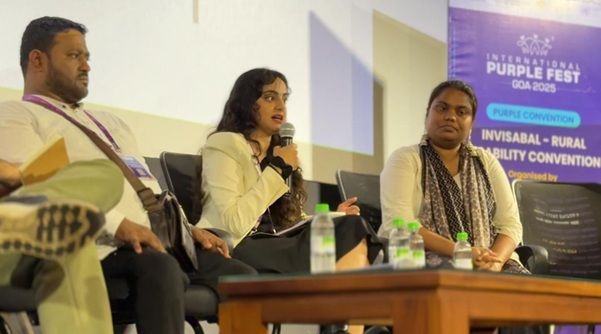
Apoorva spoke on Rural Inclusive Innovation methodologies at the InviSabal panel with the Tata Steel Foundation at the International Purple Fest 2025 in Panjim, Goa.
India’s rapid expansion in IoT, smart surveillance, and AI-driven security systems has brought data privacy into sharp focus. From CCTV networks and
biometric authentication to mobile-based identity verification, the country is building one of the world’s largest data ecosystems. Yet, within this transformation lies a complex paradox: the same data pipelines raising privacy concerns are also enabling unprecedented breakthroughs in accessibility.
 For millions of Indians with disabilities, especially those with visual or motor impairments, access to everyday systems such as banking, governance, and identity verification, often remains deeply uneven. Technologies like Seeing AI demonstrate this tension clearly. Acting as a “virtual eye,” such tools can read documents, detect objects, and even guide users to signature fields. But they also require processing sensitive personal data, often raising concerns around where that data goes and how it is used.
 This is not a new trade-off. Historically, accessibility has been a quiet catalyst for technological advancement. Alt text and captions that were originally designed for people with vision impairments or low-bandwidth environments, have become foundational datasets for training computer vision systems. Today, those same systems power generative AI, enabling machines to create images from text. Accessibility, in many ways, has been the unseen infrastructure behind modern AI.
But in India’s current IoT and security landscape, the stakes are higher. For individuals with motor disabilities, even something as basic as writing or signing a document can be a barrier to accessing financial systems, government schemes, or legal identity. Increasingly, mobile cameras and sensor-based systems are being used to track facial movements, gestures, and expressions to enable interaction without touch. These systems, while powerful, operate at the intersection of biometric data, surveillance, and personal autonomy.
It is within this intersection that Apoorva Avadhana’s work offers a critical alternative.
At forums such as International Purple Fest, where global conversations on inclusion meet grassroots realities, Apoorva emphasizes a shift in thinking: accessibility is not about high-end solutions, but about enabling “survival, dignity, and participation.” Speaking at the InviSabal panel on rural inclusive innovation, she had highlighted how technologies designed for controlled, urban environments often fail in rural India, where infrastructure is fragile, maintenance is limited, and costs are prohibitive.
Her work directly engages with one of the most overlooked barriers in India’s digital ecosystem: the inability to produce a consistent signature. Without it, individuals can be excluded from banking, welfare enrollment, and identity systems. While biometric solutions exist, they often introduce new privacy risks and dependencies on centralized systems.
 Through her research with the NYU Ability Project, Apoorva contributed to the development of a low-cost, open-source assistive tool that reimagines this problem through a privacy-aware lens. Using AI-based face mesh tracking, the tool converts subtle neck movements into digital strokes, allowing users with severe mobility impairments including quadriplegia to draw signatures independently.
Crucially, the system operates differently from conventional camera-based tracking technologies. It runs locally on the device, does not capture or store images, and instead relies on geometric relationships such as the distance between facial keypoints like the eyes and nose to interpret movement. The output is stored directly on the user’s phone, ensuring that sensitive data, including signatures, never leaves the device.
In an era where IoT systems often default to cloud-based data processing and continuous surveillance, this approach is significant. It demonstrates that accessibility does not have to come at the cost of privacy. Instead, through thoughtful design, it is possible to build systems that are both empowering and secure.
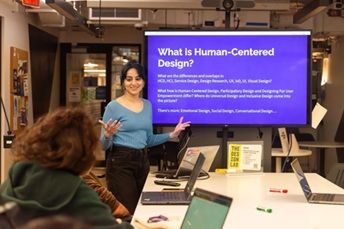 Apoorva’s broader methodology, what she terms ‘receptive design’, extends beyond technology itself. It is participatory in nature and receptive to people’s everyday way of living and working. Her work draws from India’s culture of ‘jugaad’, emphasizing adaptability, local materials, and co-creation with communities. Whether it is designing assistive tools that function without a stable internet or leveraging everyday devices like smartphones as accessibility interfaces, her approach resists the notion that innovation must be expensive or centralized.
Her professional experience with organizations such as IBM and MetLife further grounds her work in large-scale systems, where accessibility, security, and compliance intersect. Yet, her focus remains consistent: designing technologies that work in the real world, across diverse socio-economic conditions.
As India continues to expand its IoT and surveillance infrastructure, the question is no longer just how to secure data but also how to ensure that the systems built on that data are inclusive by design. Accessibility and privacy are often framed as competing priorities. Apoorva Avadhana’s work challenges that assumption, showing that they can and must be designed together.
Because in a data-driven society, true security is not just about protecting information. It is about ensuring that the systems we build do not exclude the very people they are meant to serve.
Apoorva Avadhana is a Mumbai-based design researcher focused on accessibility, inclusive design, and assistive technology. Affiliated with NYU’s Ability Lab and CPACC certified, she combines grassroots innovation with low-cost, open-source solutions to improve daily living accessibility. With experience working with IBM, TSB, and MetLife, she also leads workshops on accessibility and design thinking. Her work spans research, teaching, and AI-driven inclusion, grounded in the belief that disability is shaped by societal barriers rather than individuals.