


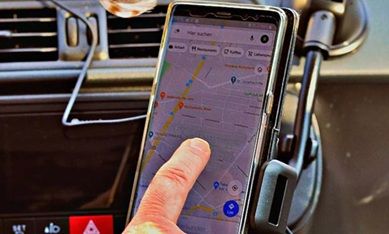
Imagine this: your smartphone isn’t just guiding you to your favourite cafe or tracking your online deliveries. It might also be quietly observing your every move figuring out whether you’re sitting, walking, or even waving your hand without ever turning on its camera or microphone. Sounds like science fiction? Researchers at the Indian Institute of Technology (IIT) Delhi say this GPS surveillance is very real.
A team from IIT Delhi, led by Professor Smriti R Sarangi and M.Tech student Soham Nag, has revealed how your Android phone’s GPS could be a much more powerful tool than most of us realise.
Their study published in the prestigious ACM Transactions on Sensor Networks shows that with “precise location” permissions, apps could use GPS data to uncover a surprising amount of information about your surroundings and activities.
Traditionally GPS is thought of as a navigation tool, a way to get from point A to point B, not a surveillance tool. But the IIT Delhi study shows that the signals your phone receives from satellites contain hidden clues about the world around you.
Using subtle features like Doppler shifts, signal strength, and even reflections from nearby surfaces (known as multipath interference), researchers found they could infer whether a person is sitting, standing, walking, or lying down.
It doesn’t stop there. AndroCon, the system they developed, can also detect if you’re on the metro, strolling through a park, or in a crowded plaza. Even the layout of indoor spaces, including rooms, staircases, and elevators, can be mapped with remarkable accuracy all by analyzing GPS signals and movement patterns.
Over a year-long study covering 40,000 square kilometres, AndroCon identified human activities with up to 99% accuracy. It even distinguished subtle gestures, like hand-waving near a phone. Indoor floor plans created using this method had errors of less than four meters, a level of detail that’s both impressive and, frankly, a little unsettling.
Experts warn that granting precise location access to apps can have consequences most users never consider. While GPS helps with navigation, ride-hailing, package tracking, this “fine-grained” data could be used to monitor your environment and movements. That too without your knowledge!
The study demonstrates that Android apps don’t even need access to cameras, microphones, or motion sensors to collect intimate details about users. By combining classic signal processing techniques with machine learning, AndroCon turns ordinary GPS readings into a sophisticated, covert sensor.
This revelation opens doors to exciting possibilities for smart services. They respond to user context such as apps that adapt to your location or activity. Yet it also highlights a significant security gap. Any app with precise location permissions could potentially spy on a user’s surroundings. Now this raises important questions about digital privacy.
For smartphone users, the message is clear. Think carefully before granting apps access to your precise location. That simple permission could reveal much more about your life than just where you are