

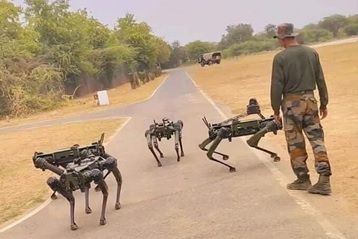
The Indian Army’s recent deployment of the Multi-Utility Legged Equipment (MULE), commonly called robotic mules or robotic dogs, represents a significant technological advancement in enhancing security and operational efficiency along the Line of Control (LoC) in Jammu and Kashmir.
These unmanned ground vehicles have been inducted in large numbers-reportedly 100 units-across the LoC, including the strategic Sunderbani sector. Designed to assist soldiers in harsh terrains, they augment logistics, surveillance, and reconnaissance capabilities, all while easing the physical burden on personnel amid extreme environmental conditions.
The MULE robots are quadrupedal machines engineered to carry loads of up to 15 kilograms, capable of transporting supplies such as food, ammunition, and water. What makes them especially valuable is their ability to navigate treacherous landscapes: they can climb steep hills, cross rivers, tackle stairs, and traverse narrow pathways—tasks that are traditionally challenging even for human soldiers or pack animals. Equipped with state-of-the-art sensors including infrared and optical cameras, these robots function in both day and night settings, effectively enhancing border surveillance.
Their operational temperature range is remarkable, designed to perform reliably from icy -40 degrees Celsius to scorching +55 degrees Celsius, thus ensuring year-round utility in diverse weather conditions.
Army officials have highlighted that the MULE’s modular design allows customization for different roles such as perimeter security, explosives detection, and intelligence gathering.
Additionally, the robots can operate collaboratively in swarms to cover larger areas and facilitate real-time data sharing, which increases situational awareness without putting troops at risk.
The twenty-first-century security architecture at the LoC has become increasingly complex, with the Indian Army integrating cutting-edge technologies to bolster defensive and offensive readiness. The deployment of these robotic mules follows successful trials during key military operations like Operation Sindoor and extends to humanitarian efforts such as earthquake relief operations in Myanmar under Operation Brahma, where robotic dogs entered collapsed buildings for reconnaissance and search-and-rescue missions.
At the LoC in Jammu and Kashmir’s Rajouri district, these advancements are part of a layered counter-infiltration strategy that combines smart fencing, UAV (unmanned aerial vehicle) surveillance, radars, and all-terrain military vehicles like the Mahindra Armado. The MULE robot’s presence eases the logistical burden in treacherous zones, improves rapid response capability, and reduces dependence on animals traditionally used in mountainous areas. It reflects the Army’s vision to replace about 50-60% of animal transport with robotic alternatives by 2030, thereby modernizing border management sustainably.