


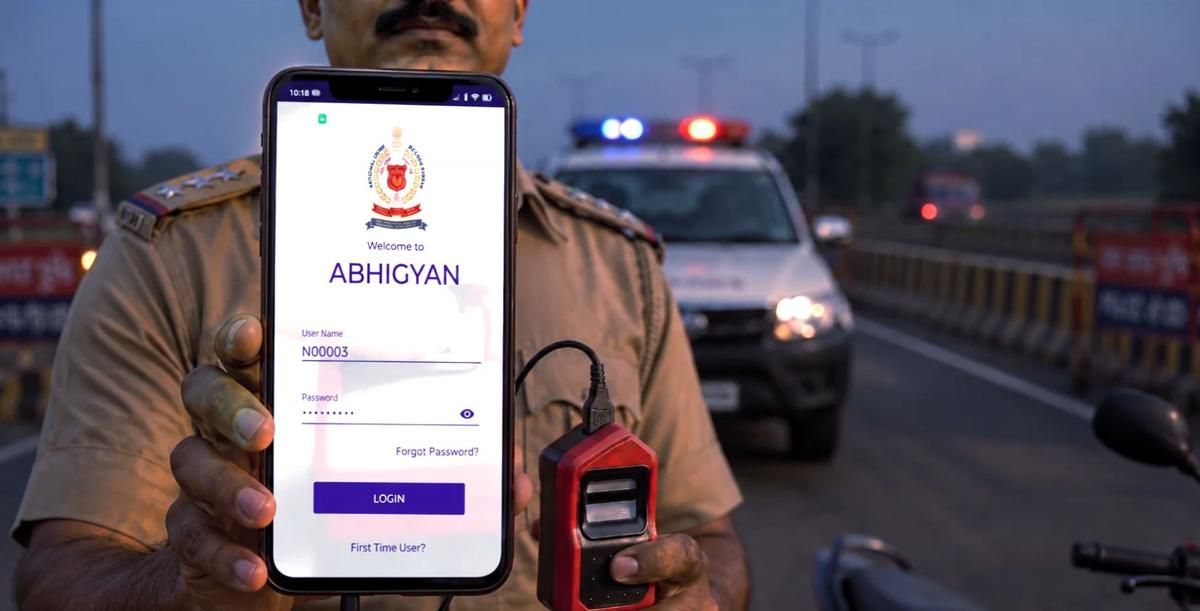
Police personnel and investigative agencies across India will soon be able to verify fingerprints of individuals on the spot using a smartphone application connected to a nationwide database containing records of more than 1.3 crore accused persons, convicts and prison inmates. The new mobile application, named Abhigyan, was launched by Union Home Minister Amit Shah.
Developed by the National Crime Records Bureau, the app is integrated with the National Automated Fingerprint Identification System (NAFIS), a centralised repository of fingerprint records collected from criminal investigations and prison systems across the country.
According to a demonstration presented during the launch, law enforcement personnel equipped with portable fingerprint scanners can capture a person’s thumb impression and compare it against the NAFIS database in approximately 35 seconds, the newspaper reported.
The demonstration suggested that officers conducting routine vehicle inspections or field patrols could scan the fingerprints of individuals they consider suspicious and immediately access any available criminal history.
“During routine vehicle checks on the streets, biometric scans of any suspicious individual can be conducted to identify persons wanted in connection with crimes. Field officers can get the criminal history of the suspect in a few seconds. This will provide protection to the police officials, as they will be alerted of the presence of a hardened criminal,” say reports.
The rollout marks a significant expansion of access to the NAFIS system. Until now, fingerprint verification against the national database was limited to more than 1,500 dedicated workstations located at police stations and district headquarters, requiring individuals to be physically brought to those facilities for verification.
An NCRB official said that the legal framework for the initiative is provided by the Criminal Procedure (Identification) Act, 2022. However, questions have been raised about whether the law permits biometric collection from individuals who have neither been arrested nor convicted.
Section 3 of the Act authorises the collection of measurements, including fingerprints, from convicted persons, arrested individuals and certain categories of persons ordered to furnish security for maintaining peace or good behaviour. The law does not explicitly provide for random biometric checks of people who are not linked to any criminal offence, say reports. Speaking at the launch, Shah said the application would allow frontline police personnel to access criminal records directly from their mobile devices.
“Secured with two-step authentication, it allows real-time fingerprint identification within seconds, strengthening ground-level policing. Equipped with features such as fast identification, portability, and access to millions of records, ‘Abhigyan’ is a highly powerful tool,” the Minister said.
Shah said the NAFIS database currently contains records related to nearly 9.91 lakh narcotics offenders, 3.65 lakh human trafficking cases and extensive prison databases. He stressed that the system’s effectiveness depends on continuously expanding the database through fingerprint collection from crime scenes and improved use of forensic evidence, including DNA samples.
The Home Minister also called for more practical police training, emphasising scientific investigation methods, evidence preservation and the preparation of concise chargesheets.
“If courts are still presented with 250 pieces of evidence, even after matching fingerprints, telephone tower data, facial recognition, iris scans, and DNA, then the technology serves no real purpose,” Shah noted.