

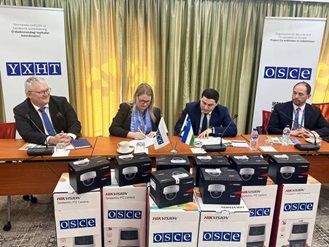
The Organization for Security and Co-operation in Europe (OSCE) has donated 40 CCTV cameras to the State Border Service of the Republic of Uzbekistan, marking a step forward in strengthening the country’s border management and surveillance capabilities.
A formal handover ceremony was held on February 3, highlighting the importance of the initiative in enhancing monitoring and operational control along Uzbekistan’s frontiers. The equipment will be installed at key border checkpoints, with priority given to the strategically significant Ayritom Border Crossing Point on the Uzbek-Afghan border.
“The OSCE is proud to provide this advanced surveillance equipment to our partners in Uzbekistan’s State Border Service. Deployed at Ayritom and other critical crossing points, these cameras will empower border guards to enhance surveillance, detect illicit activity more effectively, and secure checkpoints. We are deeply grateful for the generous financial contribution of the United States, which has been fundamental to realizing this project,”
Ambassador Antti Karttunen, Head of the OSCE Project Co-ordinator in Uzbekistan, voiced.
This support is delivered through the OSCE extrabudgetary project, “Strengthening the resilience of Uzbekistan to address cross-border challenges emanating from Afghanistan”, funded by Germany, Sweden, the United States, and France.
“The United States appreciates the steadfast efforts of the State Border Service of Uzbekistan to secure its borders,” Patrick Pratt, Coordinator for Security Assistance at the U.S. Embassy in Tashkent, added. “Your work keeps Uzbekistan and the broader Central Asian region safe. The equipment provided today is part of our broader cooperation on countering transnational security threats.”
Following the donation, a coordination meeting of the project working group was held on February 4 at the Advanced Training Faculty of the Customs Institute under the State Customs Committee. Representatives from the OSCE, State Customs Committee, Customs Institute, State Border Service, and Ministry of Foreign Affairs reviewed the project’s progress and discussed the updated roadmap for 2026–2027.