


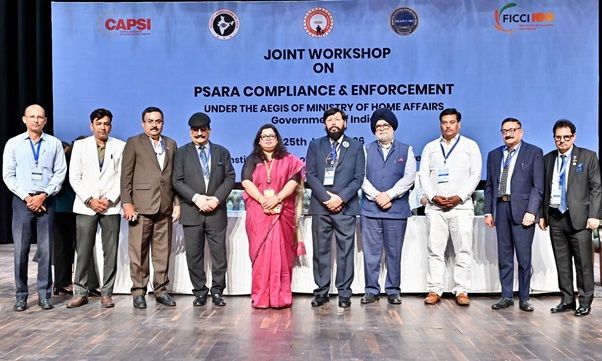
Ministry of Home Affairs (MHA) Convenes Workshop on PSARA Compliance and Enforcement
India’s private security industry, one of the country’s largest sources of employment, may be approaching its most significant regulatory overhaul since the enactment of the Private Security Agencies (Regulation) Act, 2005 (PSARA).
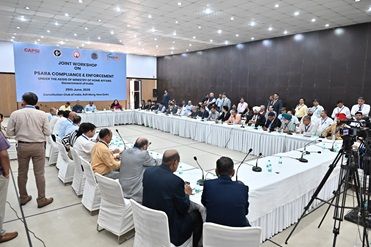
At the Joint Workshop on PSARA Compliance and Enforcement, held on 25 June 2026 in New Delhi under the aegis of the Ministry of Home Affairs (MHA), government officials, State Controlling Authorities, industry associations, and representatives of the guard workforce came together for what many participants described as a landmark dialogue on the future of the sector. The workshop was jointly organised by FICCI, CAPSI, SAI, KSSA, and BSRU and aimed to move the conversation from fragmented grievances to a structured reform agenda now being referred to as “PSARA 2.0”.
A sector too large to ignore
The discussions repeatedly returned to one central fact: private security is no longer a niche service industry. It is a major economic and employment engine.
The workshop stated that the sector provides livelihoods to nearly one crore personnel through more than 30,000 licensed agencies, while also contributing significantly through GST, professional tax, and labour welfare levies.
Industry participants argued that the scale of the sector has outgrown the administrative framework created two decades ago. Demand for private security surged after the 2008 Mumbai attacks and again during the COVID-19 pandemic, reinforcing the industry’s role as a critical support system for businesses, institutions, and public infrastructure. Market estimates presented during the workshop placed the industry at USD 5–5.5 billion today, with projections ranging from USD 9.5–14.8 billion by 2030.
According to sources, the Ministry of Home Affairs (MHA) is expected to convene a meeting of State Home Secretaries and Directors General of Police (DGPs) in the coming weeks, to be chaired by the Union Home Secretary, where the implementation and enforcement of PSARA are likely to come under review. This is expected to be followed by a high-level meeting chaired by Union Home Minister Amit Shah, signalling the government’s growing focus on strengthening the regulatory framework governing India’s private security industry.
Well rounded representation
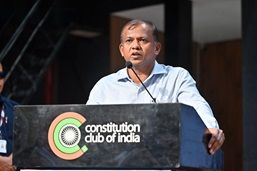 The Union Ministry of Home Affairs was represented by Mr. R. Prasanna, IAS, Joint Secretary, and Ms. Kriti Garg, IAS, Deputy Secretary, Police Modernization Division.
Senior officials serving as State Controlling Authorities and officials connected with the State Controlling Authorities included: Additional Secretary, Government of Assam, Assistant Secretary, Government of Andhra Pradesh, Under Secretary, Home Department, Government of Bihar, Additional Secretary (Home), 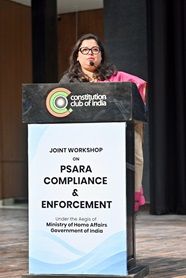 Government of NCT of Delhi, Deputy Secretary, Government of NCT of Delhi, Branch In-Charge, PSARA, Chandigarh Administration, Deputy Secretary (Home), Government of Chhattisgarh, Controlling Authority, Government of Goa, Director General of Police (Law & Order), Government of Gujarat, Additional Secretary, Government of Jammu & Kashmir, ADGP, Government of Karnataka, ADGP (Security) cum Controlling Authority, Government of Karnataka, SI, In-Charge, PSARA Cell, Government of Karnataka, Joint Secretary, Home, Government of Maharashtra, Secretary (Home), Government of Meghalaya, DGP, Controlling Authority, Government of Rajasthan, DSP, Government of Rajasthan, Officer on Special Duty, ISW, Government of Telangana, DCP, Kukatpally, Government of Telangana, Additional Secretary, SP, ISW, Government of Telangana, Additional Secretary, Government of Tripura, and DCP, Government of Uttar Pradesh
Kunwar Vikram Singh, Chairman, CAPSI delivered the welcome address and the industry’s perspective was presented by GB Singh, Member, FICCI Corporate Security & Disaster Risk Reduction Committee and Managing Director, 1st ASSET; Gurcharan Singh Chauhan, President, Security Association of India (SAI); N. Parkash, President, Karnataka Security Services Association (KSSA); Capt. Prabhat Kumar Pandit, KSSA; and V. V. Katti, National President, CAPSI.
Representing the interests of the security guard workforce, Resham Jha, General Secretary of the Bhartiya Suraksha Rakshak Union (BSRU), highlighted issues relating to the welfare, dignity, and professional recognition of security personnel and called for greater emphasis on improving working conditions alongside regulatory reforms.
The biggest complaint: Licensing delays
If one issue dominated the workshop, it was the delay in issuing and renewing PSARA licenses.
Under the current framework, fresh licenses are supposed to be processed within 60 days, renewals within 30 days, and police verification within 15 days. Yet agencies across multiple States reported that applications routinely remain pending far beyond these timelines.
Participants attributed the problem to:
- Under-resourced Controlling Authorities
- Manual routing of verification requests
- Different procedures across States
- Repeated document submissions
- Lack of specialised PSARA administration capacity
“Pendency of issuance and renewal of licenses is the basic construct from which everything else flows,” observed the Ministry of Home Affairs during the workshop.
The Ministry announced a three-month target for clearing pending licenses nationally and asked States with more than 100 pending cases to organise special clearance camps.
One Nation, One License?
Perhaps the most ambitious proposal emerging from the workshop was the repeated call for “One Nation, One License.”
Today, PSARA is implemented through 28 States and 8 Union Territories, each with its own rules, procedures, and digital readiness. Agencies operating pan-India often face multiple verification processes and varying compliance requirements.
Industry leaders proposed a unified national licensing framework administered by the MHA, while still allowing State-level administration of day-to-day operations. Supporters argued that such a system would:
- Eliminate duplicate / multiple verifications
- Create uniform standards
- Improve transparency
- Reduce compliance costs
- Enable faster nationwide operations
The idea was identified as the single most repeated demand of the day and became the first pillar of the proposed PSARA 2.0 framework.
The training crisis
Another major concern was the shortage of quality training infrastructure.
It was revealed that only around 250 actively registered training institutes exist nationally for a workforce approaching one crore guards. Participants also raised concerns about inconsistent curriculum quality and even cases of fraudulent training certificates.
Proposed solutions included:
- Using State Police and Home Guards training infrastructure for PSARA training
- Nationally standardised training programmes
- Recognition of Prior Learning (RPL) for experienced guards
- Subsidised upskilling programmes
- A common license for training institutes operating across States
Inter-ministerial coordination essential
 While the workshop was convened by the Ministry of Home Affairs (MHA) to address reforms under PSARA, participants also recognised that several of the industry’s most pressing challenges fall outside the jurisdiction of the Act itself. Issues relating to the implementation of the Labour Codes, GST compliance, delayed payments by principal employers, access to institutional finance, and ease of doing business are administered by different ministries, including the Ministries of Labour & Employment, Finance, and Commerce & Industry. It was therefore suggested that the MHA constitute an inter-ministerial working group with representatives from the concerned ministries to examine these cross-cutting issues in a coordinated manner. Such a mechanism would ensure that the reforms envisaged under PSARA 2.0 are complemented by parallel policy interventions, creating a more enabling regulatory environment for compliant security agencies while strengthening guard welfare and improving overall industry sustainability.
The missing piece: Guard welfare
The most emotionally charged discussions centred on the welfare of security guards.
Representatives of the workforce argued that PSARA remains primarily a licensing statute, with inadequate focus on the people who actually perform security duties. The workshop noted that this welfare gap has also been highlighted in judicial observations.
Key concerns included:
- Delayed wages
- Contract termination without adequate safeguards
- Lack of portability of employment records
- Inadequate social security coverage
- Protection for women guards
- Compensation for death or injury on duty
The centrepiece proposal was the creation of a National Security Guard Welfare Board that would maintain a portable employment record, police-verification history, training & skilling record and smart-card identity for every guard while helping resolve disputes between guards, agencies, and principal employers.
Although much of the discussion centred on licensing, training and enforcement, participants also highlighted the growing financial stress caused by delayed payments from principal employers. Security agencies are expected to pay wages and statutory dues on time irrespective of whether they have received payment from their clients. With payment cycles often stretching to 45–90 days, agencies are compelled to finance payroll through borrowings, significantly increasing their cost of operations. As the PSARA 2.0 framework takes shape, policymakers may also need to examine the responsibility of principal employers in ensuring timely settlement of monthly invoices. Just as agencies are expected to comply with labour laws, end users should be expected to follow responsible payment practices. Timely payments by principal employers are not merely a commercial issue, they are fundamental to ensuring wage security, statutory compliance and the long-term sustainability of India’s private security industry.
The unlicensed market problem
Interestingly, the workshop did not focus only on easing compliance for licensed agencies. It also highlighted a major enforcement gap.
Participants estimated that only about 40% of agencies operate within the formal licensed sector, leaving a substantial portion of the market outside PSARA’s reach. Unlicensed operators can undercut compliant agencies by avoiding statutory costs altogether.
Housing societies, smaller hospitals, schools, hotels, and other establishments employing in-house security staff or sourced from agencies falling outside the PSARA framework were cited as examples of the challenge. The workshop recommended coordinated enforcement drives against unlicensed operators and unregulated deployments.
A digital-first PSARA
 Not all reforms would require amending the Act.
Many participants argued that a large share of industry frustration stems from administrative and technology issues that could be resolved relatively quickly through an upgraded PSARA portal. Suggestions included:
- Pre-populated verification forms
- Carry-forward of verification across States
- Online grievance ticketing
- Mid-application address updates
- A complete digital registry of agencies and guards
The workshop explicitly noted that this digital-first pillar could move fastest because it does not necessarily require legislative amendments.
The four pillars of PSARA 2.0
By the end of the workshop, a broad reform architecture had emerged around four pillars:
- Structural Centralisation:“One Nation, One License” under a unified MHA-led framework.
- Institutional Follow-Through: National and State Regulatory Boards with formal industry representation.
- Workforce-Centred Reform:A National Security Guard Welfare Board with portable records and benefits.
- Digital-First Administration: An upgraded PSARA portal, interoperable verification, and a national digital registry.
What happens next?
The workshop concluded with a roadmap divided into short-term, medium-term, and long-term actions.
Immediate priorities include clearing license backlogs, rolling out integrated verification checklists, onboarding all States fully onto the digital portal, and creating a grievance ticketing system.
Medium-term goals include training standardisation, portability of verification across States, and stronger enforcement against unlicensed operators.
Long-term measures include evaluating the feasibility of a unified national license, establishing the Welfare Board, creating regulatory boards, and embedding guard welfare directly into the Act.
A turning point for the industry
For years, discussions around PSARA have largely revolved around compliance burdens and operational difficulties. What made this workshop different was the presence of all three stakeholder groups on one platform—government, industry, and the guard workforce.
The resulting conversation was no longer about isolated grievances. It was about whether India’s private security sector should continue to be regulated as a fragmented commercial activity or evolve into a nationally coordinated, digitally managed, workforce-centred security ecosystem.
Whether every proposal becomes policy remains to be seen. But one conclusion from the workshop was unmistakable: the debate has moved beyond fixing PSARA’s procedures. It is now about redefining the role of private security in India’s broader security architecture.
And that is why the phrase heard repeatedly throughout the day—“PSARA 2.0”—may prove to be far more than a slogan, while hopefully, One Nation, One License may become a reality.