


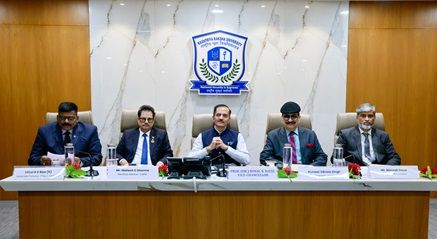
Rashtriya Raksha University (RRU) and the Central Association of Private Security Industry (CAPSI) have signed Memoranda of Understanding to develop an indigenous framework for the training, assessment and professional certification of private security professionals, centred on a proposed “Bharat Gold Standard” aligned with India’s regulatory, operational and technological requirements.
The MoU brings together RRU’s academic, training, research, simulation and assessment capabilities with CAPSI’s industry network and understanding of operational requirements, placing the training institution and the employing industry within the same standards-development framework.
During the signing ceremony at the RRU campus in Gandhinagar, Vice Chancellor Prof. Bimal N. Patel interacted with the CAPSI delegation on the larger direction of professionalising private security in Bharat. The RRU side included Shri Nimesh Dave, Director, SICSM, and Lt Col B. S. Rao, Coordinator, along with other University representatives.
The CAPSI delegation was led by Kunwar Vikram Singh, Chairman, CAPSI, and included Shri Mahesh Sharma, Secretary General, CAPSI; Shri Anil Puri, National Vice President, CAPSI; Shri V. V. Katti, President, CAPSI; Col. A. K. Singh, COO, SSSDC; Dr. Sheetal Nair, President, CAPSI Gujarat Chapter; Dr. R. K. Tyagi and Shri R. P. Chauhan, National Vice Presidents, CAPSI; Shri Sanjeev Bhardwaj, National Secretary (Reforms), CAPSI; Shri Anil Rai, Honorary Secretary, SAG; Shri Rajesh Pillai, General Secretary, CAPSI Gujarat; Shri I. P. Singh, Vice President, CAPSI Gujarat; Shri Rajesh Yadav, Deputy General Secretary, CAPSI Gujarat; and Shri R. K. Chaturvedi, Treasurer, SAG.
The institutional engine for this initiative will be RRU’s Advanced Security Skills Training Centre, conceived as an industry-aligned platform for young entrants, serving security personnel seeking advancement, ex-servicemen and former police personnel transitioning to civilian security, private security agency owners and managers, and professionals working in risk, compliance and facility management.
The Centre moves training beyond conventional classroom instruction by combining legal and operational foundations with simulation, laboratory exposure, scenario-based learning and physical preparedness. Its training ecosystem encompasses driving and firing simulators, OSINT and technology laboratories, drone training, K9 exposure, maritime-security facilities, a dedicated Private Security Lab, moot-court exposure and human-performance infrastructure.
This infrastructure enables private security training to reflect the environment in which security is now actually delivered. Physical guarding is increasingly integrated with CCTV analytics, electronic access control, alarm systems, drones, digital communications and AI-enabled platforms. Accordingly, the framework will treat technology literacy as a core professional competency, enabling personnel to develop capability across prevention, detection, reporting, escalation and first response rather than remaining confined to traditional guarding functions.
The significance of the Skill Centre lies not merely in the number of people it can train, but in the professional architecture it aims to create around the individual security practitioner. The proposed system seeks to link training with practical assessment and certification so that competence is demonstrated rather than inferred from course attendance.
It can enable personnel to progress from entry-level guarding and site duties to supervisory positions, specialised functions in areas such as K9, drones, OSINT and technology-enabled security, and ultimately managerial, consulting and entrepreneurial roles. Training of trainers, executive education and continuing professional development can, in turn, carry these competencies into private security organisations across the country.