


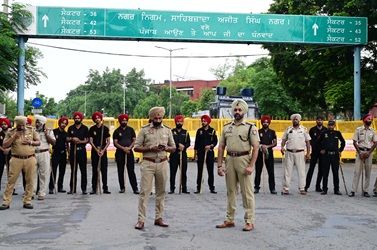
The Chandigarh administration has approved a plan to build 15 permanent security check posts at key border points adjoining Punjab and Haryana for deployment of police response vehicles, as officials seek to address gaps that have allowed suspects to flee crime scenes within minutes.
The measures, cleared by the Appraisal Committee, are intended to improve response times and strengthen surveillance at key entry and exit points in the city, where police say offenders have increasingly exploited porous borders and delayed interception.
Estimated to cost ₹5.9 crore, the project is expected to be completed within six months. The check posts will come up in Naya Gaon, Jayanti Majri, Mullanpur barrier, Sarangpur barrier, Togan barrier, Makhanmajra, Raipur Kalan, Dhillon barrier, Kishangarh, Zirakpur barrier, Faidan barrier, Mohali barrier, Badheri barrier, dividing road (Sectors 55/56), and Jampur barrier.
The project provides for standardised single-storey RCC (reinforced cement concrete) security check posts equipped with an office, control room, record room, security barrack/rest room, pantry, toilet facilities and other essential infrastructure.
The proposal has been formulated on the basis of joint inspections and recommendations of the CRPF, Chandigarh Police, urban planning and the engineering departments for relocation of checkpoints to strategic border locations in view of urban expansion and prevailing security requirements.
“The project will strengthen border surveillance, access control and round-the-clock security operations while providing improved operational and welfare facilities for deployed security personnel,” a statement of the administration reads.
Police officials say the current system relies heavily on “ill-equipped” temporary checkpoints, which are deployed periodically and require significant manpower. “The absence of permanent positioning delays interception on the ground,” said a senior police official, seeking anonymity. “By the time a naka is set up, offenders may already be out of the city.”
The push follows a series of incidents in which suspects escaped before police could respond. In one recent case, assailants shot dead a chemist store cashier in Sector 11 and escaped within minutes, remaining untraced for days. The murder happened barely 100 metres from a police naka.
In Chandigarh’s Sector 9 in March, a 31-year-old realtor was shot point blank in a crowded, high-security zone. The attackers fled the city within minutes. In the same month, gunshots rang out at Panjab University, where armed assailants targeted a student leader. The attackers fled dramatically, even hijacking a motorcycle at gunpoint before escaping.