

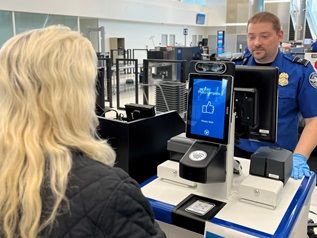
The Transportation Security Administration (TSA) recently deployed a new technology in which passengers at select airports have their picture taken to match their ID shown to TSA officers. The facial recognition technology is in operation at 84 airports across the country with plans to expand it to 400 U.S. airports over the next few years, according to the TSA.
The technology has not been met without controversy, however, with some wondering if the technology is causing privacy issues.
Here’s what you need to know about facial recognition technology and how it will affect you on your next flight. The TSA’s Credential Authentication Technology (CAT) has actually been in use for years to identify travelers and flight details. But what’s changed about the technology is that the new CAT-2 units are equipped with a camera to take photos of passengers in real-time.
The TSA says this technology is “key” to identifying passengers in the security-screening process. “This technology enhances detection capabilities for identifying fraudulent IDs such as driver’s licenses and passports at a checkpoint and it increases efficiency by automatically verifying a passenger’s identification,” Gerardo Spero, TSA’s Federal Security Director for Pennsylvania and Delaware, said in a press release. “We just want to ensure that you are who you say you are.”
The TSA claims it does not store the photos taken during facial recognition scans to prove identity. “Under normal operating conditions TSA facial recognition technology deletes traveler data and images immediately after your identity is verified, the TSA noted on its website. ”If you use TSA PreCheck Touchless Identity Solution, your information is deleted 24 hours after your scheduled departure time.”
However, the agency noted that there are some instances where TSA will save the photos and data to test the accuracy of the facial recognition technology, but claims that passengers will be notified.
There are concerns that the data may be held for longer than the few seconds it takes to verify someone’s identity and used for other purposes they did not agree to, like surveillance and tracking, according to critics of the technology. Travelers can directly state to a TSA agent at a security checkpoint that they do not want their photo taken and want to opt out. The agent should follow the standard procedure of visually matching your face to your ID as it has traditionally been done.
“Travelers who do not wish to participate in the facial recognition technology process may decline the optional photo, without recourse, in favor of an alternative identity verification process, which does not use facial recognition technology to verify their identity,” according to the TSA.