



Amid rising geopolitical tensions and recent reports questioning the integrity of surveillance systems, the global CCTV industry is confronting a growing trust deficit. Allegations of vulnerabilities and potential misuse, whether verified or not, have accelerated the shift toward zero-trust frameworks. Governments worldwide, including India, are tightening regulations to prioritise secure, auditable, and sovereign surveillance ecosystems. As CCTV evolves into a networked, data-driven platform, the central question is no longer capability, but trust – who controls the data, and who is watching the watchers?
A recent report published in Vision Times, and circulating on social media platforms and in international media alleges the detention of over 300 executives and R&D personnel from Hikvision.
Interestingly the report says that these executives have been “taken away by Chinese authorities” Now that, certainly sounds strange, as it is believed that Hikvision which operates across more than 180 countries and plays a significant role in global security infrastructure is partially a state owned Chinese company and is probably the world’s largest manufacturer of CCTV and AI-enabled surveillance systems. So, why would the Chinese government arrest or take away for questioning, one of its own company’s employees?
The alleged reason is linked to incidents in which the U.S. military reportedly captured Venezuelan leader Nicolás Maduro and Iranian officials were killed in strikes. Surveillance systems in both Venezuela and Iran were said to have been supplied by Hikvision. The vulnerabilities in Hikvision’s surveillance systems were exploited by the United States and Israel, leading to the elimination of both the Venezuelan leader and top ranking Iranian officials. Reports, although unconfirmed, claimed that all Hikvision surveillance systems in China are now being replaced.
The concern centres on the apparent ease with which backend systems could be accessed, raising the possibility that surveillance networks might be leveraged by external actors to extract sensitive information. This has reportedly prompted a degree of introspection within China itself, acknowledging that cameras manufactured domestically could, in theory, be exploited to transmit live feeds from sensitive locations to foreign entities. If such vulnerabilities exist, it also implies that similar systems deployed within China could be exposed to the same risks, potentially allowing critical data to be accessed by external state actors.
This points to a broader phenomenon of reverse surveillance, where the watchers themselves come under watch, challenging long held assumptions of control and security. Systems designed to safeguard strategic interests may, under certain conditions, become conduits of exposure. The question this raises is both immediate and consequential: in an interconnected surveillance ecosystem, can any deployment truly be considered secure without absolute control and verification?
This development has once again placed the global video surveillance industry under intense scrutiny. Reports alleging the detention of personnel from Hikvision have reignited concerns over potential vulnerabilities and the misuse of surveillance systems. While these claims remain unverified, they have further fuelled an expanding global conversation around trust, control, and accountability within surveillance ecosystems. If borne out, the implications point to deeper systemic challenges spanning cybersecurity, geopolitical risk, and the overall integrity of surveillance infrastructure. The pattern they point toward is unmistakable: surveillance infrastructure is now being treated as a national security asset, not just a security tool.
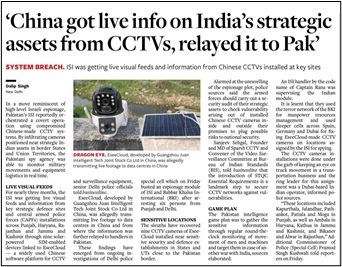 Closer home, an investigative report by BusinessLine (as seen in the shared clipping) claims that compromised Chinese-origin CCTV systems were allegedly used to transmit live visual feeds from sensitive Indian locations, including defence installations and CAPF sites, to external entities in Pakistan. The report suggests that live feeds were accessed over a period of months, solar powered 4G/5G cameras were linked via cloud platforms such as “EseeCloud”, and data was allegedly transmitted to servers outside India and further relayed.
While these claims are based on ongoing investigations and official confirmation remains limited, the implications are serious. The suggestion that surveillance systems themselves could become intelligence collection tools fundamentally alters how such technologies must be evaluated. Importantly, industry voices quoted in the report have called for urgent security audits of all strategic assets, highlighting vulnerabilities arising from installed CCTV infrastructure.
The Convergence of Surveillance and Geopolitics
Over the past decade, video surveillance has undergone a profound transformation, from being a passive, record-and-review mechanism to becoming an intelligent, networked ecosystem driven by data. Modern CCTV systems are now equipped with capabilities such as facial recognition, behavioural analytics, object tracking, and even predictive threat detection. In effect, they have evolved into real time intelligence platforms, deeply embedded within the operational fabric of critical infrastructure, smart cities, transportation networks, and defence environments.
 This shift has significantly elevated their strategic value. Surveillance systems are no longer just tools for safety and security; they are repositories of sensitive data and, potentially, instruments of strategic leverage.
Against this backdrop, concerns, whether arising from verified incidents or even plausible vulnerabilities, take on far greater significance. The possibility that such systems could be exploited for intelligence gathering raises a fundamental and uncomfortable question: who ultimately controls the data, and who has access to it?
Governments across the world are increasingly viewing foreign origin surveillance technologies through a national security lens, especially when deployed in sensitive or mission-critical environments. The issue extends well beyond the physical hardware. It encompasses the entire digital ecosystem: data transmission pathways, cloud dependencies, firmware integrity, remote access protocols, and the latent risk of embedded vulnerabilities or backdoors.
As these concerns deepen, the debate is gradually shifting from performance and cost to assurance and control, setting the stage for a more fundamental rethink of trust itself in surveillance architectures.
Zero Trust
 A deepening trust deficit in global surveillance supply chains is increasingly pushing the CCTV debate toward a ‘Zero Trust’ approach. Incidents such as these, whether fully substantiated or still under scrutiny, feed into a broader pattern of unease around foreign origin systems, raising a fundamental question: can any supply chain be implicitly trusted anymore?
The emerging global consensus is not based on proving guilt, but on eliminating risk. This is where the concept of Zero Trust becomes critical, and when applied to surveillance systems, Zero Trust implies that no device or vendor is inherently trusted, whether Indian, Chinese, or from any other origin. Every component must be verified, audited, and continuously monitored. Data flows must be controlled within sovereign or trusted environments and supply chains must be transparent and certifiable.
India in recent years realised this and has been steadily moving to restrict the sale of untested and uncertified internet connected CCTV and other IoT devices, unless they meet stringent certification requirements established by STQC and MeiTy, reflecting a shift toward trusted and verified surveillance ecosystems.
This is a clear signal: security is now inseparable from sovereignty. So, another question that arises is; can a surveillance system be considered secure if its data pathways are not fully sovereign and auditable?
The Circuit Is No Longer Closed
 Traditionally CCTV, or “Closed-Circuit Television,” refers to a video surveillance system in which cameras transmit footage to a restricted set of monitors or recording devices, rather than broadcasting it publicly. However, modern CCTV systems have evolved well beyond these traditional ‘closed-loop’ configurations.
Today, they are cloud-connected, software driven, AI enabled, and remotely accessible platforms. While the term “CCTV” still persists, rooted in an era when analogue cameras operated over dedicated coaxial cables in isolated networks, the reality is very different. Contemporary systems are smart, built on open architectures, designed for interoperability, and deeply integrated into networked environments with remote access capabilities.
This evolution, while enhancing functionality, also introduces multiple layers of vulnerability. Risks now extend to firmware level backdoors, unauthorised remote access, data exfiltration to offshore servers, and potential manipulation across the supply chain. Even in the absence of confirmed breaches, the mere possibility of such exposure constitutes a significant strategic risk.
Cybersecurity Vulnerabilities and System Integrity
 Modern surveillance systems are deeply integrated into digital networks, making them susceptible to cyber exploitation. Allegations, such as those in the referenced articles, about vulnerabilities being exploited for intelligence purposes resonate with industry wide fears.
The risks include unauthorized remote access, data interception and manipulation, system hijacking for espionage, and compromised AI analytics leading to false intelligence
For end users, particularly governments and critical infrastructure operators, this raises urgent questions about system integrity, vendor transparency, and lifecycle security management.
STQC Mandate and the Push for Trusted Surveillance
The rollout of STQC certification, despite its immediate disruption to the CCTV industry, is fundamentally designed to address long-standing concerns around the integrity and security of surveillance systems. Under the new framework, all internet-connected CCTV devices must undergo rigorous government testing, covering hardware, software, and even source code validation, to ensure they meet defined standards of cybersecurity and reliability. This is particularly significant in light of past concerns over vulnerabilities in imported systems, including risks of data being transmitted to offshore servers. By enforcing encryption, secure firmware, and elimination of backdoor access, STQC-certified systems are inherently more resistant to unauthorized intrusion and exploitation.
 At a broader level, the mandate also introduces a structural shift in how surveillance trust is established. By making certification compulsory for manufacturing, import, and sale from April 2026, the government is effectively filtering out unverified and potentially high-risk devices from the ecosystem. This reduces dependence on opaque supply chains and ensures that only tested and auditable systems are deployed, particularly in critical infrastructure. While the transition has led to supply bottlenecks and industry slowdown in the short term, the long-term impact is likely to be the creation of a more secure, standardised, and sovereign surveillance environment—where the risk of compromise is significantly minimised through design, not just detection.
Can Certification Alone Deliver Secure Surveillance?
While the current STQC mandate is centred on CCTV cameras, a surveillance system is an ‘end-to-end networked ecosystem’, and its security is only as strong as its weakest link. Network components such as switches, routers, storage devices (NVRs/DVRs), and even cabling interfaces play a critical role in how data flows, and how it can be intercepted or manipulated.
Switches, in particular, can present serious vulnerabilities if compromised:
- Traffic interception and mirroring: A malicious or compromised switch can duplicate video streams and silently forward them to external endpoints.
- Firmware backdoors: Like cameras, switches run firmware that can potentially be exploited for unauthorised access.
- Network manipulation: VLAN hopping, ARP spoofing, or port hijacking can redirect or disrupt surveillance feeds.
- Remote access exploits: Unsecured management interfaces can allow attackers to reconfigure network behaviour.
In such a scenario, even a fully STQC-certified camera can be rendered insecure if the network layer is compromised. This highlights a critical gap, device-level certification without network-level assurance creates a false sense of security.
Going forward, a more holistic approach will be necessary. This could include:
- Certification or standards for network infrastructure components
- Mandatory end-to-end encryption of video streams
- Adoption of zero-trust network architecture within surveillance deployments
- Continuous monitoring and audit of network behaviour, not just endpoints
In essence, securing surveillance systems cannot stop at the camera. It must extend across the entire data chain, because in a connected environment, control of the network often means control of the system itself.
Impact on the Indian Security Ecosystem
For India’s physical security industry (PSI), these developments are both a challenge and an opportunity. On one hand, the dominance of cost-effective imported surveillance equipment has long influenced market dynamics. On the other, increasing regulatory scrutiny and security concerns are accelerating the push toward indigenous manufacturing, compliance driven procurement, and cyber secure surveillance architectures.
In such a setting domestic players such as CP Plus, Prama, Sparsh and Matrix are likely to gain market share as policy frameworks prioritize trusted sources and certified technologies. However, even these ‘indigenous’ manufacturers making products under the ‘Made in Bharat’ banner, import most of their components from overseas supply chains, and they too need to be careful and use the zero trust policy while choosing their vendors and at every step of the processes they follow.
Also, and more importantly, system integrators and consultants will need to evolve from hardware-focused deployments to risk-aware, security-first design approaches.
The Road Ahead: From Surveillance to Secure Surveillance
The future of the surveillance industry will be shaped not just by technological advancement, but by the credibility and trustworthiness of the systems deployed. The direction of travel is clear – greater emphasis on cybersecurity certifications and rigorous audits, increasing demand for transparent and accountable supply chains, deeper integration of zero-trust principles into surveillance networks, and a more prominent role for AI governance and ethical oversight.
The narrative itself is undergoing a shift – from asking, “Can it monitor?” to questioning, “Can it be trusted?”
Irrespective of whether the reported detentions at Hikvision are ultimately verified, the broader signal is evident. The global surveillance landscape is moving into a phase where technology, security, and geopolitics are tightly interwoven.
For stakeholders in India and across the world, this presents a critical inflection point, to reassess existing dependencies, reinforce standards, and invest in surveillance ecosystems that are resilient, secure, and above all, trustworthy.
Because in an increasingly connected world, the greatest risk is not surveillance itself, it is the uncertainty surrounding who is watching the watchers!