


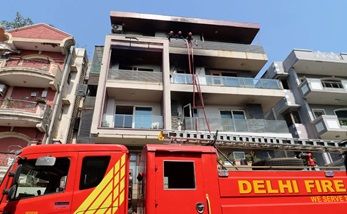
The Delhi government is reviewing a key fire safety exemption framework that currently allows nearly 95 per cent of residential buildings in the capital to bypass mandatory fire safety clearance, in a move aimed at tightening enforcement after a series of deadly fire incidents, officials have said.
Power Minister Ashish Sood said the government is examining whether the existing building height-based exemption system needs revision to strengthen fire safety compliance across residential areas, especially amid rising risks linked to heavy electricity usage and dense urban construction.
The proposal under consideration may lower current height thresholds that determine whether a fire No Objection Certificate (NOC) is required before electricity connections are granted.
At present, under Delhi Electricity Regulatory Commission (DERC) guidelines, electricity distribution companies can provide connections without fire safety clearance for residential buildings up to 17.5 metres with stilt parking and up to 15 metres without stilt parking.
This system effectively determines fire safety compliance for most residential structures, as electricity connections are often issued without separate fire clearance within these limits.
Officials said this has created a wide regulatory gap, with a large share of low-rise and mid-rise buildings in Delhi remaining outside mandatory fire safety certification despite increasing electrical load in homes.
The framework is based on Delhi Fire Service rules, which classify buildings above 15 metres as high-rise and subject them to stricter fire safety norms and mandatory clearance.
However, planning relaxations under the Delhi Master Plan allow residential buildings with stilt parking to go up to 17.5 metres without being treated as high-rise for certain approvals. Over time, this dual system, fire safety rules on one side and planning and electricity norms on the other, has created inconsistencies in enforcement.
DERC guidelines have effectively become the key checkpoint for deciding whether fire safety clearance is required before granting electricity connections. Officials estimate that nearly 95 per cent of residential buildings in Delhi currently fall outside mandatory fire safety certification requirements due to the existing height-based exemption structure.
This means most of the city’s housing stock is not routinely subjected to fire safety inspection at the construction stage or before electricity connection, raising concerns over preparedness in densely populated residential areas