



In recent years, there has been a significant shift as businesses increasingly embrace cloud infrastructure to drive growth, enhance operational flexibility, and cultivate innovation. As more organizations transition to cloud-based solutions, artificial intelligence has emerged as a pivotal force, fundamentally transforming the way these environments are managed. AI’s integration into cloud infrastructure goes far beyond automating routine tasks, it is redefining IT operations by enabling real-time performance optimization, predictive analytics, and intelligent resource allocation. These advancements empower companies to operate more efficiently and scale their operations seamlessly, effectively responding to evolving business needs.
For any organization that is using Cloud services, security is of the highest priority to them. AI helps enhance threat detection and response capabilities to revolutionize Cloud security. Large amounts of data can be analysed by AI systems to identify odd patterns and any security loopholes to address the chances of security threats often before they occur. Moreover, AI also continually monitors systems and automatically updates security protocols to ensure the business’s compliance with industry standards. With a proactive approach, it helps safeguard data and increase client confidence.
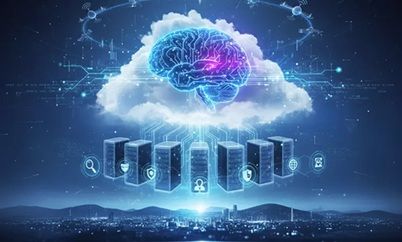 By accelerating digital transformation, reducing operational costs, and supporting strategic agility, AI is enabling businesses to thrive in an increasingly technology-driven marketplace. Whether it’s through self-healing systems that address technical glitches autonomously or smart algorithms that allocate resources based on real-time demand, AI is at the forefront of shaping the future of cloud operations. As we explore these developments, it becomes clear that the synergy between AI and cloud infrastructure is not just a trend, but it’s a critical driver of sustained success in today’s competitive landscape.
Significance of AI in Transforming Cloud Infrastructure and IT
Artificial intelligence including machine learning, generative AI, and AI agents is reshaping how organisations design, run, secure, and optimise cloud platforms and IT services. As estates become more cloud-native (microservices, Kubernetes, serverless) and multi-cloud, operational complexity grows faster than teams can scale.
AI helps bridge that gap by converting high-volume telemetry and operational data into faster decisions, automated actions, and continuously improving systems. AI enables a shift from reactive to proactive operations to enhance system reliability, resource utilization and cost efficiency.
Key applications include predictive analytics for dynamic scaling, anomaly detection for identifying threats and bottlenecks, real-time resource optimization and AI-driven security tools that ensure data protection and compliance.

1. Smarter Operations: From Monitoring to AIOps and Self-Healing
- Noise reduction and faster triage: AI correlates metrics, logs, traces, and events to suppress alert storms and surface the few signals that matter.
- Root-cause analysis at cloud scale: Pattern learning across distributed systems helps pinpoint likely causes faster than manual investigation.
- Automated remediation: When combined with runbooks, policy controls, and GitOps/IaC, AI can trigger safe actions such as rollbacks, scaling and restarting failed components.
- Predictive operations: Forecasting demand and saturation enables proactive capacity planning and reduces outages and mean time to recovery (MTTR).
2. Modern Platform Engineering: Better Cloud Architecture and Platform Engineering
AI accelerates modern platform engineering by helping teams standardise “golden paths” for building and running services. Assistants can generate and review infrastructure-as-code (e.g., Terraform), recommend cloud reference architectures, and detect drift from approved landing zones. Used well, AI improves consistency across environments (dev/test/prod), shortens build times, and reduces configuration errors that commonly lead to incidents.
3. Stronger Security: Continuous, Adaptive, and Automated
- Threat detection and anomaly spotting: ML models can detect unusual access, data movement, or workload behaviour that indicates compromise or misuse.
- Cloud security posture management (CSPM) at scale: AI can prioritise misconfigurations and vulnerabilities based on exposure, blast radius, and business criticality.
- DevSecOps automation: AI-assisted code review and security testing can catch issues earlier (secrets in code, insecure configurations, vulnerable dependencies).
- Faster response: Integration with SOAR and incident response workflows can speed containment and evidence collection, while keeping humans in control for high-impact actions.
4. Cost Management: Effective Performance Optimisation
 Cloud costs are highly elastic, and easy to waste. AI supports FinOps by forecasting spend, detecting cost anomalies, recommending rightsizing, and optimising purchase decisions (reserved capacity/commitments) based on usage patterns. When paired with SLO/SLA targets, AI can also tune scaling policies to balance performance with cost, improving unit economics (e.g., cost per transaction) rather than only reducing bills.
5. Higher Productivity: From Service Desk to Software Delivery
- Service desk augmentation: Virtual agents can resolve common tickets (password resets, access requests, troubleshooting) and draft consistent responses from knowledge bases.
- Faster delivery cycles: Generative AI helps with code scaffolding, test generation, documentation, and CI/CD troubleshooting, freeing engineers for higher-value design work.
- Cloud migration and modernisation: AI can assist with application discovery, dependency mapping, refactoring suggestions, and automated documentation during migration programmes.
6. Governance, Compliance, and New Risks to Manage
AI-driven infrastructure must be governed like any other critical system. Organisations need clear guardrails (policy-as-code, RBAC, change windows, approval workflows), strong data protection (to avoid leakage of sensitive telemetry, credentials, or customer data), and model risk management (quality, bias, explainability, and drift). Where AI initiates changes, teams typically adopt “human-in-the-loop” controls for high-risk actions and maintain auditable logs of AI recommendations and executions.
Current challenges in using AI

- Data Quality and Context Gaps: Telemetry is noisy, inconsistent, and often missing key context (ownership, criticality, dependencies), limiting model performance.
- Tool Sprawl and Integration Complexity: AIOps value depends on integrating observability, ITSM, CI/CD, CMDB/asset inventory, IAM, and cloud control planes.
- Trust and Explainability: Operations teams need to understand “why” a model recommends an action especially for high-blast-radius changes.
- Safe Automation Boundaries: Moving from recommendations to autonomous actions requires guardrails (policy-as-code, approvals, blast-radius checks, rollback) and rigorous testing.
- Skills and Operating model: Success needs joint DevOps/SRE/SecOps/FinOps ownership; many organisations still run siloed processes and unclear accountability.
- Regulatory and Audit expectations: Regulated environments require evidence trails, segregation of duties, and demonstrable control effectiveness for AI-assisted decisions.
Common AI-for-Cloud use cases:
| Use case | What AI does | Typical input signals | Primary KPIs improved |
| Alert Noise Reduction | Groups/deduplicates alerts; correlates across services; highlights probable causes | Logs, metrics, traces, topology, change events | MTTD, alert volume, on-call hours |
| Root Cause Assistance | Ranks hypotheses; proposes diagnostics; links to similar past incidents | Runbooks, tickets, incident postmortems, observability data | MTTR, repeat incident rate |
| Predictive scaling | Forecasts demand; adjusts scaling/placement policies | Traffic history, seasonality, business events, resource saturation | Latency, error rate, cost per request |
| Automated Remediation | Executes pre-approved fixes with policy gates and rollback | Event streams, config state, approvals, guardrails | MTTR, change failure rate |
| Cloud Posture Prioritization | Prioritizes misconfigurations by exposure and impact | CSPM/CIEM findings, asset criticality, exploit signals | Time to remediate, risk reduction |
Security Enhancements through AI in Cloud Infrastructure
 AI strengthens cloud security by improving signal quality, increasing the speed and accuracy of detection, and enabling more consistent enforcement of controls across dynamic environments. In practice, it works best when integrated with cloud-native telemetry, policy engines, and security workflows, so insights can be validated and turned into controlled actions. By combining various technologies and automating selected processes throughout your Cloud environment, AI can streamline these workflows.
1) Threat detection, correlation, and faster incident response – Anomaly detection on cloud telemetry, Alert deduplication, Guided triage, SOAR enrichment and playbook acceleration.
2) Stronger posture management and misconfiguration prevention – Risk-based prioritisation, Drift detection and Control recommendations.
3) Identity security (ITDR) and privileged access protection – Suspicious sign-in analysis, Privilege misuse detection, Access guardrails.
4) Data protection – Automated data discovery, Context-aware classification, Exfiltration and leakage signals.
5) Application, container, and Kubernetes security at scale – Vulnerability prioritisation, Runtime behavioural analytics and Secure SDLC support.
6) Threat intelligence, hunting, and continuous attack surface mapping – Faster research-to-detection, Automated hypothesis generation and Attack surface visibility
The significance of AI in cloud infrastructure and IT lies in its ability to reduce operational friction while improving reliability, security, and cost efficiency. By augmenting teams with better insights and selective automation, AI enables IT to move from reactive work towards proactive optimisation and faster digital delivery, provided it is implemented with strong governance and engineering discipline.
The author is Program Director – Cyber Security & Data Privacy at Tata Consultancy Services (TCS), with over 22 years of global leadership experience in cyber risk and resilience. She has advised Boards and executive teams across industries, leading large-scale, regulator-driven cybersecurity, AI, PCI, and SOC transformations for Tier-1 banks and global enterprises. A trusted advisor to the C-suite and regulators, she delivers resilient, compliant, and scalable cyber operating models.